Handmade in rural Zhejiang, China

Founder & Maker · ZendoDream
Victor Zhang
I make botanical incense by hand, in small batches, in rural Zhejiang, China.
My work begins with real plants, slow preparation, and a belief that scent can be personal: quiet, recognizable, close to daily life.
Why Victor Zhang
My name is Zhang Zhuoqi (张卓奇). I took the name Victor while studying in Spain. There were so many Victors in my class that people started calling me “Victor Zhang.” It stayed with me.
When I built ZendoDream, I kept it. It felt like an easier name for people to remember, and by then it already felt like part of my story. A small detail, but it is how most people first meet me.
Where I Come From
I am from Zhejiang, on the eastern coast of China. Where I grew up, incense is part of ordinary life. Many households use stick incense for ancestral rites and seasonal rituals.
So I knew the smell of incense long before I ever thought of making it myself. It was not a brand idea at first. It was something already present in the background of home.
The scent of real plants — now yours, and only yours.
The kind people come to know you by.
The beginning
How It Really Began
A lost job, a faint fragrance, and the woman who became my teacher.
ZendoDream’s age
4
Years
0
Months
The real beginning came from two things. In 2022, during the pandemic, I lost my job. My wife and I took the chance to travel to a neighboring province to clear our heads.
Near an old landmark, a faint fragrance drifted past us. We followed it to a traditional-style building, stepped inside, and met the woman who became my teacher: Ms. Wang.
What surprised me most was my wife. Modern perfume bothers her, yet she loved this scent completely, right from the first whiff. That was the moment scent stopped being background and became something I had to understand.
The craft
Materials, Methods, and Meaning
Seven or eight powders, ground to 120 mesh, pressed by hand.
Materials and Methods
In that time I learned the broad families of scent and the materials I now return to most: agarwood, lemongrass, aged tangerine peel (chen pi), and osmanthus.
I also learned the core ways of making: blending (he xiang), sealed maturing (yin xiang), and sun-drying.
A single blended piece often needs seven or eight different powders. Just preparing the materials can take days, and that is before counting the earlier processing.
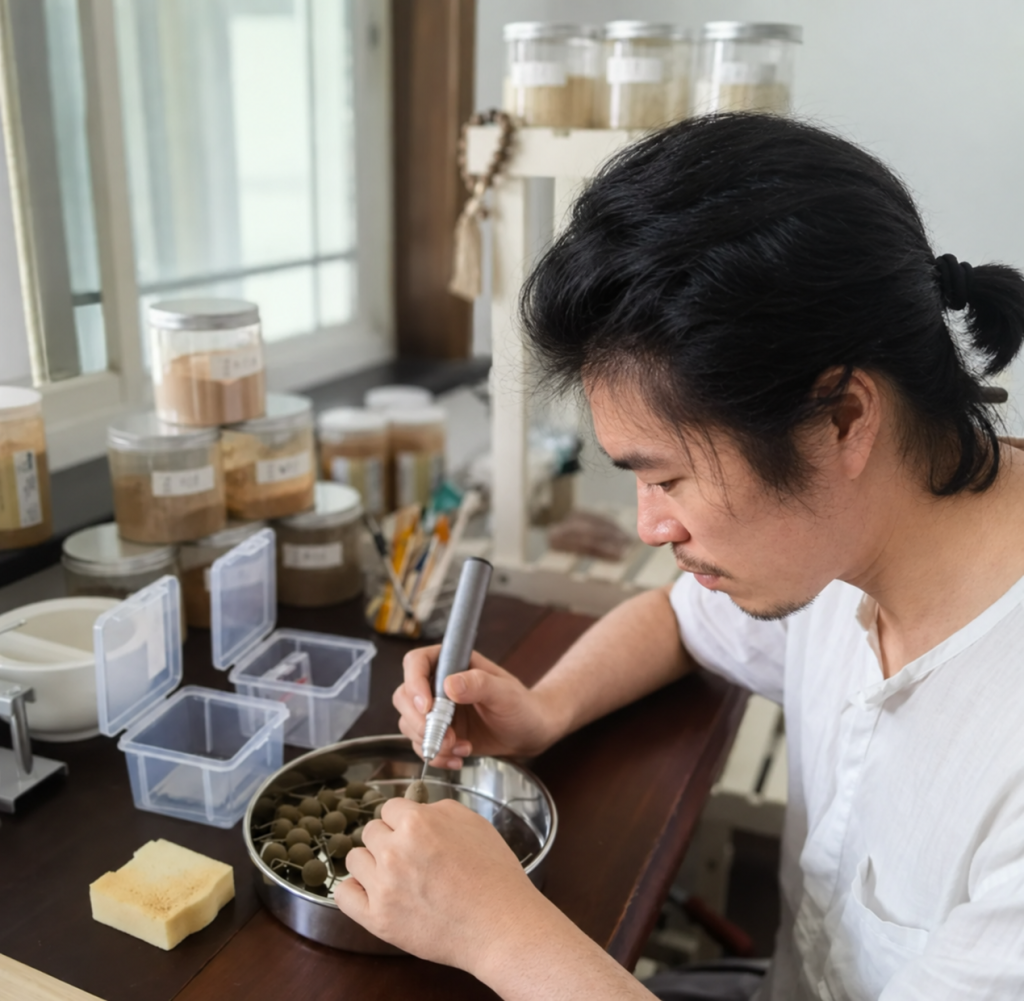
What I enjoy most is the blending. Following a formula, I prepare the materials, mix them, add water at about 0.7 times their weight, and knead slowly until the surface turns smooth.
The Work by Hand
What tests me most is the processing of the raw materials. Every material needs a different treatment, and that takes real patience.
The part I like least is grinding. But for a piece to come out beautiful, the powder has to be fine: 120 mesh. Half a day of grinding yields one material, and only a few hundred grams.
Then I weigh each portion precisely and press it into a mold. There is something deeply calming in that moment, though the slightest carelessness marks the surface and the piece has to be made again.
Somewhere in the making, I came to feel that loving scent is a quiet kind of richness, and that what a person loves says something singular about them.