Handmade in rural Zhejiang, China

How I Pick Chinese Mugwort at Duanwu
Picking Chinese mugwort (Artemisia argyi) around Duanwu — the lunar fifth month — from Gaoyang Mountain in Zhejiang. The plant of Lunar May.


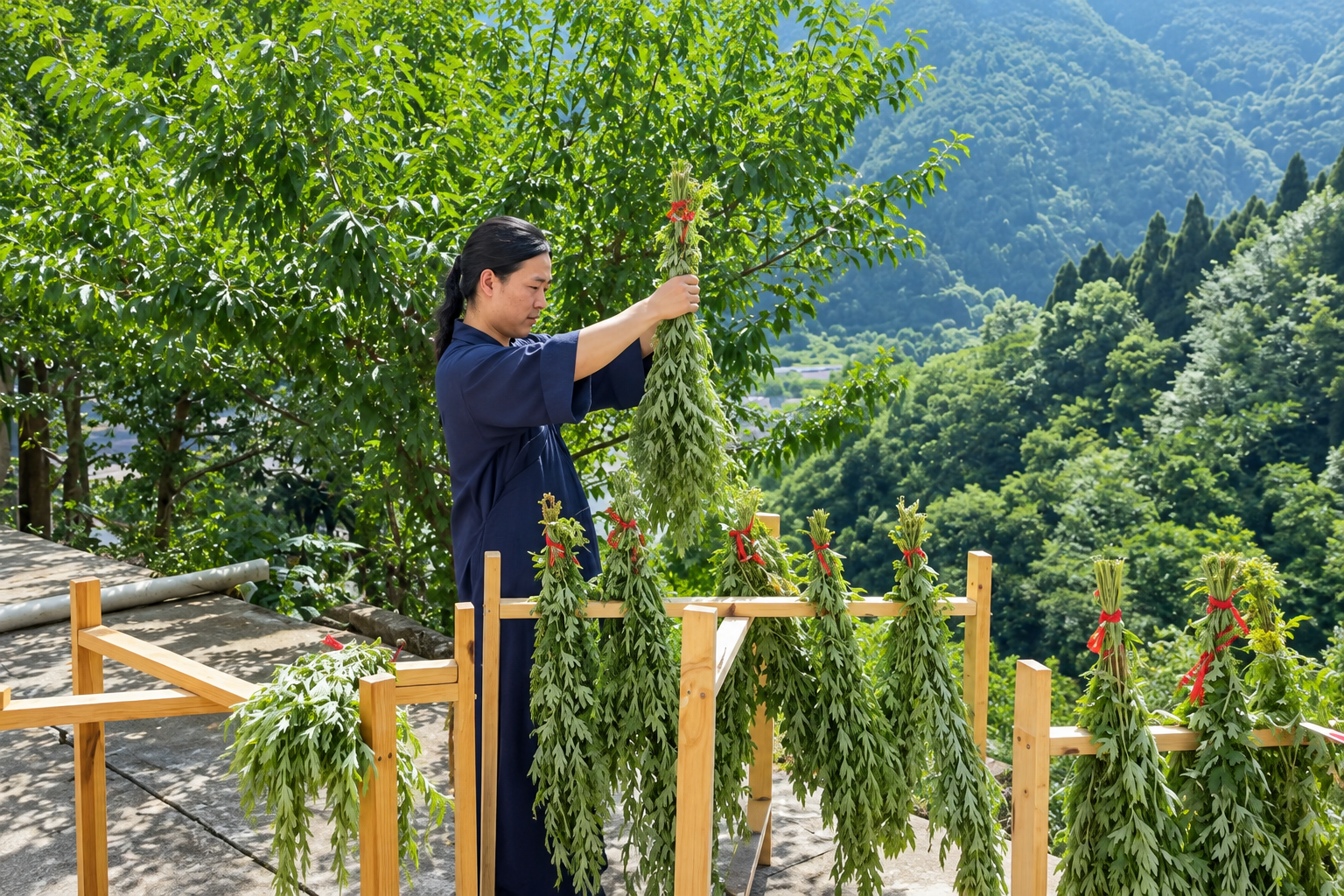
Every year around Duanwu — Dragon Boat Festival in English, the fifth day of the lunar fifth month, usually late May or early June — I go up Gaoyang Mountain at Nanbei Lake to cut Chinese mugwort, Artemisia argyi. We pick it for our incense pellets, as a middle note in some of our incense beads, and for the simpler use that may matter more to readers in mosquito-heavy climates: burning.
Below: what Chinese mugwort actually is, why this slope, when and how I cut it, why we age the dried leaves for three years, how to burn it for pest control, and where it ends up in our products.
In one sentence: Chinese mugwort (Artemisia argyi) is the herb of lunar May — used for over two thousand years in Chinese households, ritual, and medicine, with a warm, dry, slightly camphoraceous scent that sits between hay and old wood.
What Chinese Mugwort Is, and Why Lunar May
Chinese mugwort — Artemisia argyi, native to eastern China — is a perennial herb in the daisy family, distinct from Artemisia vulgaris (Western common mugwort) and Artemisia absinthium (wormwood, the absinthe plant). The leaves are silver-gray on the underside, hairy and fragrant. The scent is camphoraceous and dry — somewhere between dried hay and old wood, warmer than peppermint, drier than sandalwood. Traditional Chinese medicine has used it for over two thousand years for warming meridians and dispelling cold; moxibustion (艾灸) is its most concentrated form. The lunar fifth month is when its volatile oil content peaks, which is why Chinese households at the Duanwu Festival hang fresh mugwort above doors — a custom documented since the Han dynasty. Li Shizhen’s sixteenth-century Bencao Gangmu names mugwort one of the household herbs, with the variety from Qichun in Hubei — known as qi’ai (蕲艾) — held as the standard. Ours grows on a Zhejiang slope of similar character.
Why Gaoyang Mountain
Gaoyang Mountain (高阳山) sits at the southern end of Nanbei Lake, in Haiyan county, Jiaxing prefecture, Zhejiang — about an hour south of Hangzhou and two hours from Shanghai. At 251.6 meters, it’s the highest peak in Jiaxing, a region otherwise of rice fields and flat coastal plain.
Mugwort is one of the easier plants to find — it grows in wastelands, along roadsides, in fields. But where it grows determines the scent. Our slope is south-facing and well-drained, catches morning mist off Hangzhou Bay, and stays cooler at night than the valley below. The plants here run smaller than valley mugwort, leaves more silver underneath, volatile oil content a notch higher. We do not plant it. The same area has been giving us mugwort every year since we started.
When I Cut, and What I Cut
The window is short and culturally specific: the three days around Duanwu, when the plant’s volatile oil content is at its peak. I cut around 6:30 AM, after the dew has lifted but before the sun gets above the treeline.
What I look for:
- Plants 50–80 cm tall, not yet flowered — flowering shifts the terpene profile toward bitter
- Silver-gray undersides on the leaves, hairy to the touch — the indicator of higher volatile oil density
- Square stems with a slight pubescent texture
- A specific dry-herb-and-camphor smell when you crush a leaf between fingers — warm where peppermint is cool
I cut at the second leaf node from the top, leaving the plant to regrow. Each plant gets touched once per season. We collect about fifteen kilograms across the three-day window — far more than other herbs, because mugwort is a feature note, not a lift.
A bunch above the door. A gram inside the bead.
After the Harvest: Drying, Then Three Years of Aging
Mugwort takes longer to dry than mint — about a week to ten days in shade, single layer on bamboo trays, kept at 22–25 °C. Drying matters: too fast and the surface terpenes burn off; too slow and mold develops inside the dense leaves.
After drying, we age the mugwort for three years before milling. This is non-standard for commercial scent makers, but it follows the Chinese medical tradition: the older the mugwort, the more concentrated and rounded the aroma. The Bencao Gangmu specifically recommends three-year-aged mugwort for moxibustion — sharper notes fade, the warmth deepens. A mugwort milled the year it’s cut smells green and edged. A three-year-aged mugwort smells settled, like a warm pillow filled with old hay.
Burning Mugwort: A Quiet Pest-Repellent Tradition
Beyond ritual and medicine, dried mugwort has a third use that matters in mosquito-, tick-, or termite-prone climates: burning it as a natural insect repellent. The smoke contains eucalyptol (cineole), camphor, and thujone — compounds known to repel mosquitoes, flies, and several beetle species. Chinese households have used mugwort fumigation alongside the Duanwu door-hanging custom for centuries.
For readers in the U.S. South, Florida, the Pacific Northwest, or any region with heavy mosquito or tick pressure: a small bundle of dried mugwort, lit at one end, will smolder for fifteen to twenty-five minutes — long enough to clear a screened porch, a yard corner, or a tent perimeter at dusk. It is not as sustained as a citronella candle, but it carries no synthetic fragrance, no petroleum, no DEET. The smell is herbal, slightly camphoraceous — closer to sage smudge than to bug spray.
This is the simplest way into mugwort: no compound, no aging, no fine milling. Just dried plant and a slow burn.
Where Mugwort Lives in Our Products
Three-year-aged mugwort is a middle note in our Incense Beads, sitting at around twelve percent of the botanical mass — the warm, dry herbal layer between the wood base and the resin top. In our Incense Pellets range, it appears as a quieter background, the dry herbal trace that traditional Chinese homes know by smell. The full role of each material is in our Materials Library. For more on how we work, see About.
ZendoDream hand-blends botanical scent in small batches of 20, in rural Zhejiang, China.
The scent behind this story
Singular Rose · Heated
Sweet rose at the front, a soft tartness from roselle, a faint milky warmth underneath: 35 hand-rolled rose incense pellets in a white porcelain jar. Heated at 150°C / 300°F, never burned, so no smoke and no ash. The scent moves slowly through the room while you read or work. An incense burner is not included. Heat the pellets on a burner at 150°C / 300°F and never place them directly into a flame. How to use is below.
$68.00
View product →