Handmade in rural Zhejiang, China

What Holds a Botanical Bead Together
How plant powder becomes a wearable bead — without synthetic glue. Three natural binders, one shared rule: keep them dry.


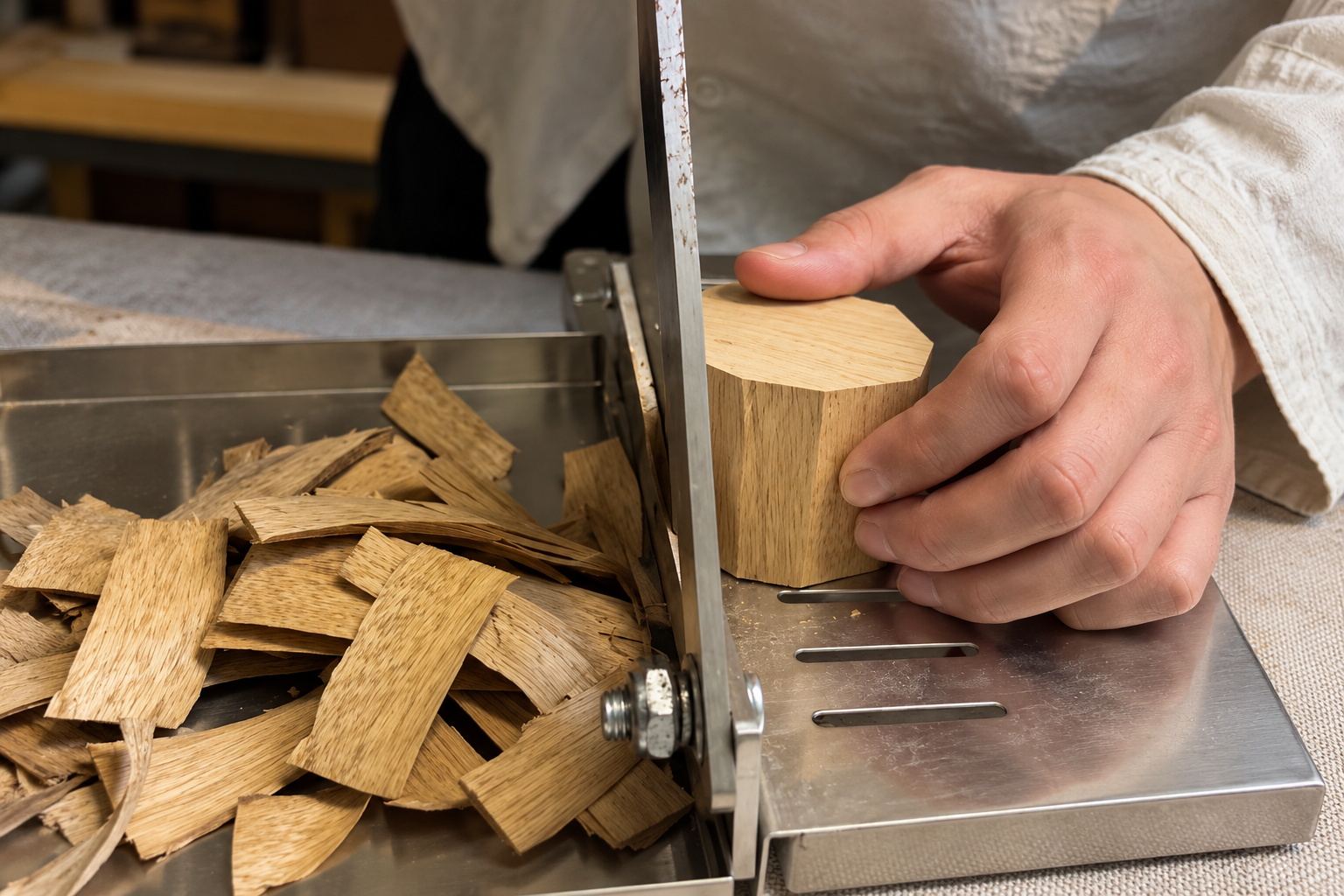
The compound bead on your wrist is real plant material. Cedar shavings, camphor dust, dried osmanthus, aged citrus peel. The ingredient list says nothing about “fragrance,” “binder,” or “polymer.” Yet powder does not form a sphere by itself. So what holds it?
The answer is older than chemistry. Three materials did this job in Chinese workshops for two thousand years: nanmu wood powder, elm bark powder, and beeswax. Below: how each one binds, and why a piece made this way almost always fears water.
In one sentence: Powder becomes a bead without modern adhesive. Wood-sap from nanmu, water-soluble gum from elm bark, beeswax that melts and re-sets — three mechanisms, one shared care rule: keep dry.
The Real Question: How Does Powder Stick to Itself?
Synthetic adhesives like PVA, latex, and epoxy arrived after 1930. Every craft tradition that turned plant powder into a solid shape before then relied on something else: a natural binder, usually plant-derived.
The shared mechanism is mucilage. A gummy compound stored inside wood or bark, which softens when wet, wraps the surrounding particles, and re-hardens when conditions return to normal. No chemical reaction. A physical state change, back and forth.
It sounds primitive. It is also stable. Three of these binders were standard equipment in Chinese incense making.
Nanmu — The Wood That Releases Its Own Sap
Nanmu refers to several Lauraceae species across two genera: Phoebe (including the architectural-grade Phoebe zhennan) and Machilus. Its fibers store a natural mucilage in crystal form. Grind to 120-mesh powder, add water, stir. The mucilage hydrates, releases, and coats whatever you mix in.
The recipe is simple. 120-mesh nanmu powder plus the aromatic powder of your choice, plus water at roughly 3:1. Knead to dough. Roll into beads or press into cakes. Shade-dry for seven days. The Japanese tradition uses a close relative, Machilus thunbergii (tabu-no-ki), sold as makko. Physical behavior is nearly identical.
Set nanmu mucilage is semi-water-resistant. It handles humidity. It does not survive a long soak.
Elm Bark — Bark That Becomes Gum in Water
The inner bark of the elm tree (Ulmus species) holds a high concentration of water-soluble mucilage. Soak or rub it briefly. Gum appears. Classical Chinese sources call the powder yumian (榆面) or yu bai pi (榆白皮).
Elm bark binds harder than nanmu. More grip per gram. The structural cost is straightforward: water re-dissolves it. The same property that makes it sticky also means moisture undoes the work. This makes elm bark a fit for short-life objects: traditional pill formulations, Tibetan incense, external poultice binders. Not for a piece meant to last years on the wrist.
The Western relative is slippery elm (Ulmus rubra) in North America. Same mucilage. Sold as throat lozenges in health-food stores, where saliva re-hydrates the powder in the mouth.
Beeswax — Heat Welds, Cooling Sets
One terminology note. In Chinese, mila (蜜蜡) can mean either beeswax or a particular shade of Baltic amber. Two completely different materials. Same color by coincidence. Here it means beeswax: wax secreted by worker honeybees from abdominal glands. Baltic amber is fossilized pine resin from 45 million years ago, hard as stone.
Beeswax melts at 62 to 65 °C. Heat it to that range, mix in powder, let it cool. The wax sets around the particles. It does not dissolve in water. It does not dissolve in oil. Of the three binders, only beeswax needs no water to work. Only beeswax is truly water-proof once set.
The trade-off is heat. Above the melt point, the bond fails. Beeswax has held together pill casings, wax-sealed letters, and furniture polish for centuries. The objects live at room temperature, away from direct sun and heaters.
Why Pieces Made This Way Fear Water
Back to the question we get nearly as often: why do ZendoDream incense beads always say “avoid water” in the care card?
Now you see.
| Binder | Water tolerance | Heat tolerance |
|---|---|---|
| Nanmu | Handles humidity; a long soak softens and deforms the piece | Stable below combustion |
| Elm bark | Dissolves on contact | Stable |
| Beeswax | Truly water-proof | Softens at 62 °C in direct sun or near a radiator |
The pattern: a piece bound with natural materials is either water-sensitive or heat-sensitive. Room temperature, shade, dry. That is the safe zone. The constraint is not a marketing line. It is a physical limit built into the binder. Modern adhesives can solve both at once, in exchange for synthetic compounds on the body. We took the other trade.
Frequently Asked Questions
Can I make compound beads at home?
Yes. The minimum recipe: nanmu powder, any dried aromatic powder (cedar shavings, camphor dust, dried osmanthus, aged citrus peel), water at about 3:1. Knead until the dough stops sticking to your hands. Roll 1.2 cm beads. Shade-dry on a bamboo tray for seven days. No equipment needed.
Is nanmu the same as Japanese makko?
Same plant family, different genus. Japanese makko mostly uses Machilus thunbergii (red machilus, tabu-no-ki). Chinese nanmu more often uses Phoebe zhennan and related Phoebe species. The two perform almost identically.
Can a bead survive a splash?
Brief splash, wiped within seconds, is usually fine. Hours of immersion warp the piece permanently and dull the aroma. Blot dry. Air-dry in shade for 24 hours.
Can someone with a bee allergy use beeswax-bound items?
Almost always yes. Beeswax has a much lower allergy rate than honey, because the pollen protein behind most bee-product reactions is nearly absent. A small number still react. First use: warm at low temperature for 5 to 10 minutes and watch.
Are all three of these “plant” binders?
Not strictly. Nanmu and elm bark are plant-derived. Beeswax is animal-derived, secreted by bees. The three are grouped as “non-petroleum, non-synthetic,” but a vegan practice would use only the first two.
ZendoDream hand-blends botanical scent in small batches of 20, in rural Zhejiang, China.
The scent behind this story
Green Hour · Worn
Green Hour is sweet, floral lavender softened by agarwood, with a gentle woody-herbal warmth. Hand-rolled from 120-mesh botanical powder in the soft olive-green of dried herbs, polished by hand and strung on clear stretch flat cord, with accessories in two styles to choose from. Wear it alone or stacked. Please enter your wrist size in cm or inches in the order notes at checkout.If none is given, we make it for a 16 cm / 6.3 in wrist. How to measure is below.
Price range: $88.00 through $98.00
View product →