Handmade in rural Zhejiang, China

Chinese Incense Is About Scent, Not Smoke
Incense sticks were made for ritual, not appreciation. The real Chinese tradition is warming scent over charcoal, never burning it.


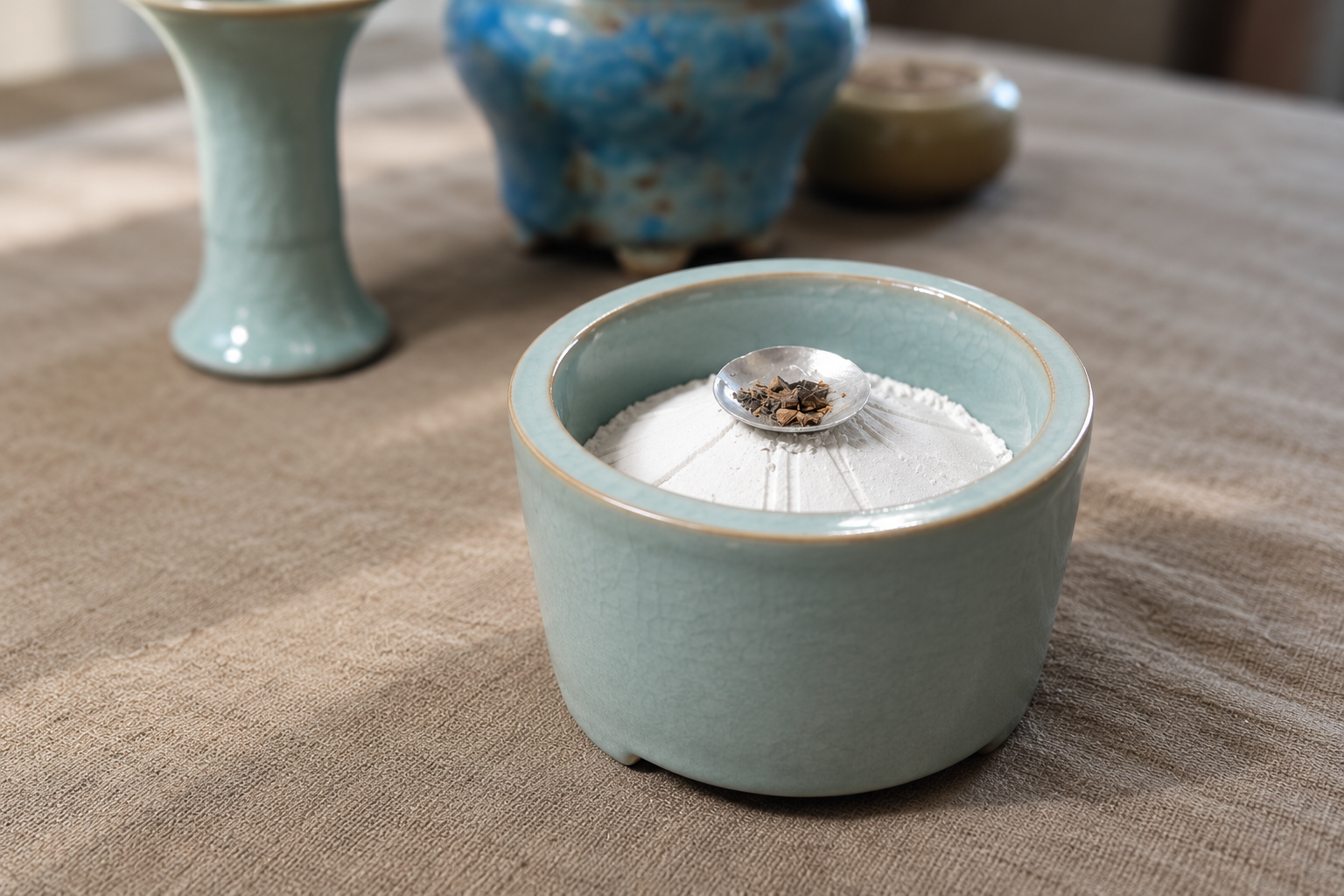
My favorite thing to do is brew a cup of tea on a rainy afternoon and slowly warm a hand-rolled osmanthus incense pellet over an indirect-heat burner. The sweet osmanthus starts as a hint at the tip of my nose, then gradually seeps into the air until the whole room is filled with it. No smoke at all — just scent. This is what appreciating incense should feel like.
I didn’t start out this way. When I first got into incense years ago, the market was almost entirely incense sticks, so I assumed sticks were the standard entry point. I bought a batch to study with. The results were disappointing. Most of them smelled wrong — you’d lean in and get a wall of synthetic fragrance instead of real plant material. Worse, every stick had to be lit with an open flame, which meant a steady column of smoke. My airways tightened, my eyes stung, and whatever scent might have been there got buried under the smoke. For a while I thought “appreciating” incense was a form of suffering.
What Incense Sticks Were Actually Made For
I had a nagging feeling that sticks weren’t the traditional method, so I dug into old texts. It turns out incense sticks are relatively new. They emerged in the Song dynasty and only became widespread in the Ming — and their primary purpose was never appreciation. It was religious ritual and timekeeping. My hometown burns sticks every year for the Qingming ancestor-worship holiday, and once you connect the two, the picture clicks: in the ancient Chinese worldview, incense sticks were a medium for reaching another dimension. They’ve been tied to temples, Daoist shrines, and family altars since the beginning. The vehicle is smoke, not scent. Smoke was believed to carry messages up to the gods, so the more billowing the better — from a ritual standpoint, that’s the whole point.
So Why Did Incense Sticks Become the Face of “Appreciation”?
If sticks are really a ritual object, how did they end up representing incense connoisseurship in the last few decades? I count four reasons.
First, cost and standardization. Sticks can be industrially extruded — uniform length, predictable burn time, easy to package and price for bulk retail. Incense pellets and cakes, by contrast, require slow hand-blending, air-drying, and aging. Production doesn’t scale, and shelf economics are ugly. Capital picks the stick.
Second, ease of use. You stick a stick into a holder, light it, done. Warming incense over ash-covered coal is far more involved: you have to prepare charcoal, bury it in ash, manage temperature, cut a mica or silver heat plate, and adjust the setup based on which material you’re using. Most consumers won’t bother, so most merchants don’t push it.
Third, the “incense revival” of the past twenty or thirty years has been shaped by commerce. The market wanted a single, easy-to-understand, visually ritualistic product to teach the average consumer with. A lit stick in a holder — or a chunk of agarwood burning directly on foil — photographs beautifully and cuts well for short-form video. That format won by default. The genuine indirect-heat tradition receded back into small circles of hobbyists and collectors.
Fourth, blowback from Japanese kōdō. Japanese incense ceremony uses sticks heavily, and Chinese sellers have leaned on that association to package sticks at an inflated price. Over time, the equation “incense culture = incense sticks” quietly rewrote public memory, and China’s own indirect-heat tradition got buried underneath.
What Appreciating Incense Actually Looks Like
If you want to actually appreciate incense, the method has always been the same: warm it, don’t burn it. You place a small piece of charcoal in a censer, cover it with a thin layer of ash for insulation, then set a heat plate — usually mica, silver, or jade — on top of the ash. Blended pellets, cakes, or pearls go on the heat plate, where they’re slowly warmed by the radiant heat coming up from the coal below. No open flame. Almost no smoke. Just scent, unfolding in layers. This is what the ancients meant by “appreciating” — 品. Directly burning something has its own words — 焚 or 爇 — and traditionally sat lower on the taste ladder. Warming over a plate was for scholars: hear the scent, don’t see the smoke. The classical incense manuals — Huang Tingjian in the Song, Zhou Jiazhou in the Ming — are all describing this technique.
Charcoal is admittedly a real barrier for beginners. Fortunately there’s now a much simpler alternative: an electric incense warmer. You plug it in, dial in the temperature, and you get the same smoke-free, controlled heat without the fire safety concerns. For anyone just starting out, this is the easiest way in.
So if you’re like me — put off by the harshness and off-scent of sticks — please don’t conclude that incense isn’t for you. You’ve just been sold the wrong product. Real incense appreciation was always about scent, not smoke. Get yourself a good pellet, a simple heat-plate burner or an electric warmer, pick a rainy day, brew some tea, and you’ll understand why the ancients ranked incense first among the four scholarly arts, ahead of tea, painting, and flower arranging.
This is the model I’ve built ZendoDream around: hand-blended osmanthus and other botanical pellets, warmed rather than burned. If you want to see what’s actually in each pellet, the Materials library breaks down every plant we use and why. The Incense Pellets are built for the electric-warmer version of this ritual, no charcoal required. And if you’re curious how a Zhejiang workshop ended up making any of this, the About page has that story.
ZendoDream hand-blends botanical scent in small batches of 20, in rural Zhejiang, China.
The scent behind this story
Singular Rose · Heated
Sweet rose at the front, a soft tartness from roselle, a faint milky warmth underneath: 35 hand-rolled rose incense pellets in a white porcelain jar. Heated at 150°C / 300°F, never burned, so no smoke and no ash. The scent moves slowly through the room while you read or work. An incense burner is not included. Heat the pellets on a burner at 150°C / 300°F and never place them directly into a flame. How to use is below.
$68.00
View product →