Handmade in rural Zhejiang, China

How to Choose Incense for Meditation
How to choose incense for meditation: why smoke matters when you sit, burned vs. warmed incense, and the best incense for meditation without smoke.


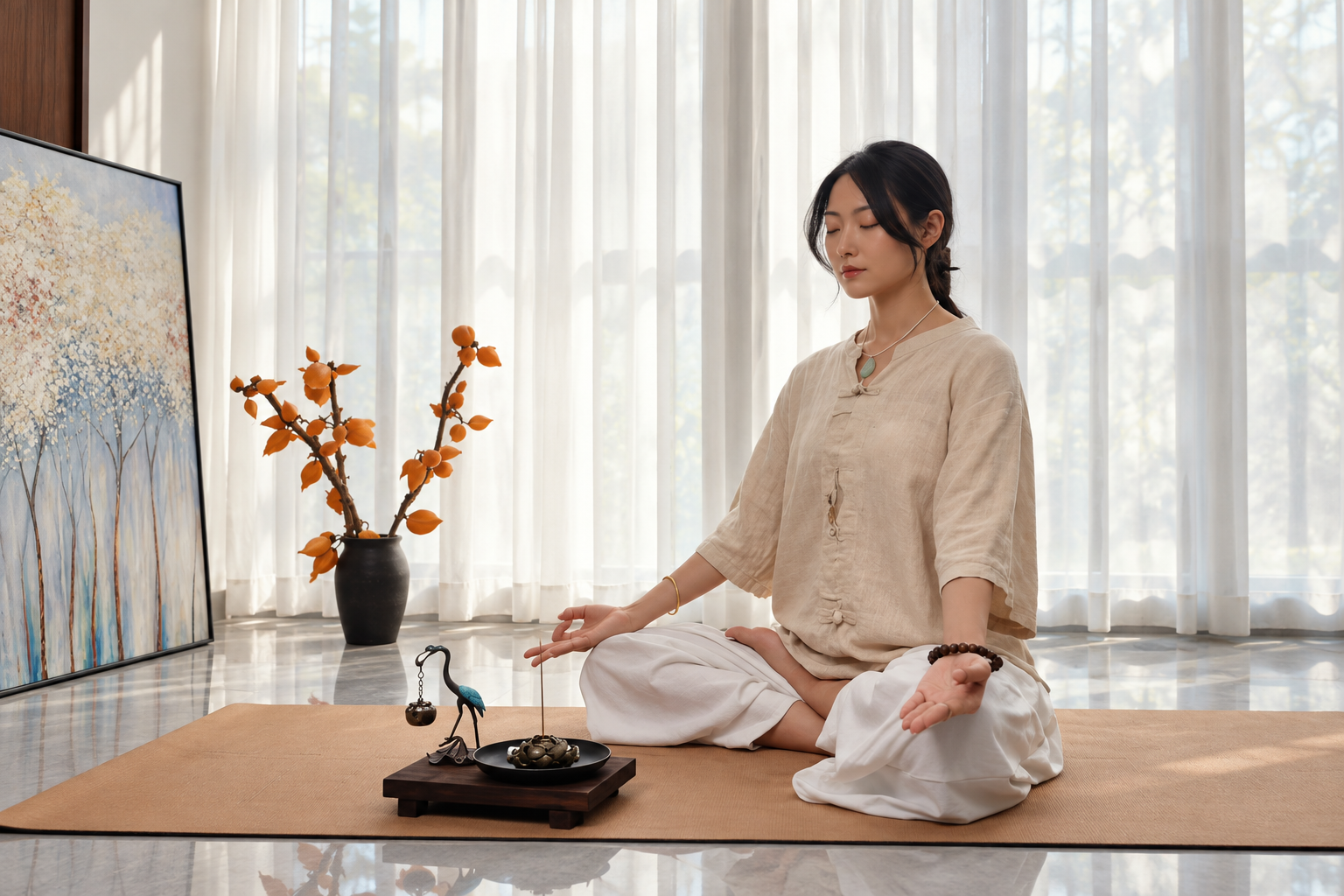
You open an app, press play on a guided track, light a stick of incense and sit cross-legged on the floor. Ten minutes later, a soft chime. Many people think that is meditation. It is only the start. Before you choose incense for meditation, it helps to know what you are actually doing when you sit.
What Meditation Actually Is
The practice goes by many names. In India it was dhyana. In China the word became chan (禅), in Japan zen, and in Europe and America, meditation. The names changed. What happens when you sit stayed much the same.
Meditation isn’t doing nothing. With practice, the mind settles faster. Thoughts thin out while attention stays sharp, and the senses open up. At first you’ll notice your head is full of what already happened and what you still have to plan. Give it time and those voices fade. You start to stay with the present. Then something else shows up: the room you thought was silent is full of sound. A clock. A car two streets away. Your own breath. Chinese has a phrase for this kind of stillness, 落针可闻: you could hear a pin drop. Only here does meditation really begin. The work from now on is to hold that attention.
Picture a jar of muddy water. Keep stirring and it stays cloudy. Leave it alone and the silt sinks until the water clears by itself. Sitting works the same way. Your body loosens a little at a time, and your mind settles with it.
Two Kinds of Stillness, Two Kinds of Incense
Once the mind is still, the path splits in two.
One belongs to religious practice. In some traditions, smoky incense, white sage among others, serves as a doorway to another state of mind. That is for practitioners, and it’s outside what this piece covers.
The other belongs to most of us. You keep that clear awareness and let your body go on relaxing. After a day of using your head, these fifteen minutes are yours. No gods to call on, no wishes to make. You just bring your attention home.
Know which path you’re on and you’ll know what to buy. For most people, I’d suggest incense with little smoke, or none at all.
Is Incense Smoke Bad for You?
Why less smoke? Burning incense releases fine particles into the air you breathe.
A study in Singapore followed more than 61,000 Chinese adults aged 45 to 74 for over a decade. People who had burned incense at home for years had a higher risk of cancers of the upper respiratory tract. It’s an observational study. It shows a link, and it doesn’t mean one stick will make you sick. Still, breathing smoke every day is no small thing.
Meditation makes it worse. You sit out of the draft, so the windows are often shut and the smoke has nowhere to go. You sit close to the incense. Your breathing slows and deepens, and each breath goes all the way in. The best incense for meditation, then, is the kind that makes no smoke.
What Is the Best Incense for Meditation?
Most people assume incense has to be burned. Around the world, though, there are two broad ways to use it. You burn it, or you warm it.
In the Middle East, it’s burned. In Oman and the UAE, people set frankincense or oil-soaked wood chips called bakhoor on glowing charcoal, then pass the burner among guests so the smoke settles into their clothes and hair. The scent is rich and the smoke is heavy. It’s a gesture of welcome, lively and warm, and not well suited to sitting alone behind a closed door.
In Japan, stick incense is the norm. Temples light one for seated meditation, and families light one at the home altar.
China has long preferred warming, and the practice goes back further. Song dynasty scholars buried charcoal in a bed of ash, laid a thin plate of mica or silver on top, and set blended incense pellets on the plate to warm through. No flame, no smoke, only scent opening in layers. In China we call this 听香, listening to the scent. You take it in with your whole attention. I wrote more about it in Chinese Incense Is About Scent, Not Smoke.
So when you choose incense for meditation, start with one question: is it burned or warmed? Sandalwood and agarwood are both fine materials. The same sandalwood still behaves very differently as a lit stick and as a warmed pellet.
How We Make Smokeless Incense
We follow the warming tradition. We blend plant materials to a formula, grind them to a fine powder, knead the powder with honey and roll it into pellets by hand. The pellets warm on a burner and never catch fire. No smoke. No ash. You can see the range on our smokeless incense page.
Our meditation blend sits on a base of sandalwood, which gives off a faint note of frankincense as it warms. Up front we added borneol. Its coolness arrives first, like the first breath of air when you open a window in the morning. It keeps you awake rather than drowsy.
How to Listen to the Scent
- Warm the burner to about 150°C (300°F), with a small plant-wax tealight underneath or an electric burner.
- Set one pellet on top.
- Sit down. Don’t go looking for the scent. Let it come to you. Notice that it’s there first, then slowly work out what it is.
- When the scent fades, your sitting is done.
FAQ
Do you need incense to meditate?
No. Incense isn’t required. It works more like a signal. When you smell it, you know it’s time to settle. When it fades, you know you can get up.
Is incense smoke bad for you?
Burning incense releases fine particles. A long-term study of more than 61,000 adults in Singapore linked years of burning incense at home with a higher risk of upper respiratory tract cancers. When you meditate with the windows shut and sit close by, incense that is warmed is the better choice.
Is sandalwood incense good for meditation?
Yes. Sandalwood is steady and doesn’t crowd you, which is why it’s the most common material in meditation incense. What matters is how you use it. A lit stick smokes. A warmed pellet doesn’t.
If you want to try listening to the scent yourself, our warmed pellets are on the Incense Pellets page.
The scent behind this story
Green Hour · Worn
Green Hour is sweet, floral lavender softened by agarwood, with a gentle woody-herbal warmth. Hand-rolled from 120-mesh botanical powder in the soft olive-green of dried herbs, polished by hand and strung on clear stretch flat cord, with accessories in two styles to choose from. Wear it alone or stacked. Please enter your wrist size in cm or inches in the order notes at checkout.If none is given, we make it for a 16 cm / 6.3 in wrist. How to measure is below.
Price range: $88.00 through $98.00
View product →