Scent as a small courtesy · Handmade in rural Zhejiang, China

Incense Beads: A Quieter Way to Carry Scent
A small pressed bead made of real botanicals, worn on the wrist. It releases at room temperature, within about 30cm; skin warmth only nudges it forward. Clear aroma for 6–12 months.


Part of a series: Types of Incense: A Beginner’s Path to Botanical Scent, read 5 of 7.
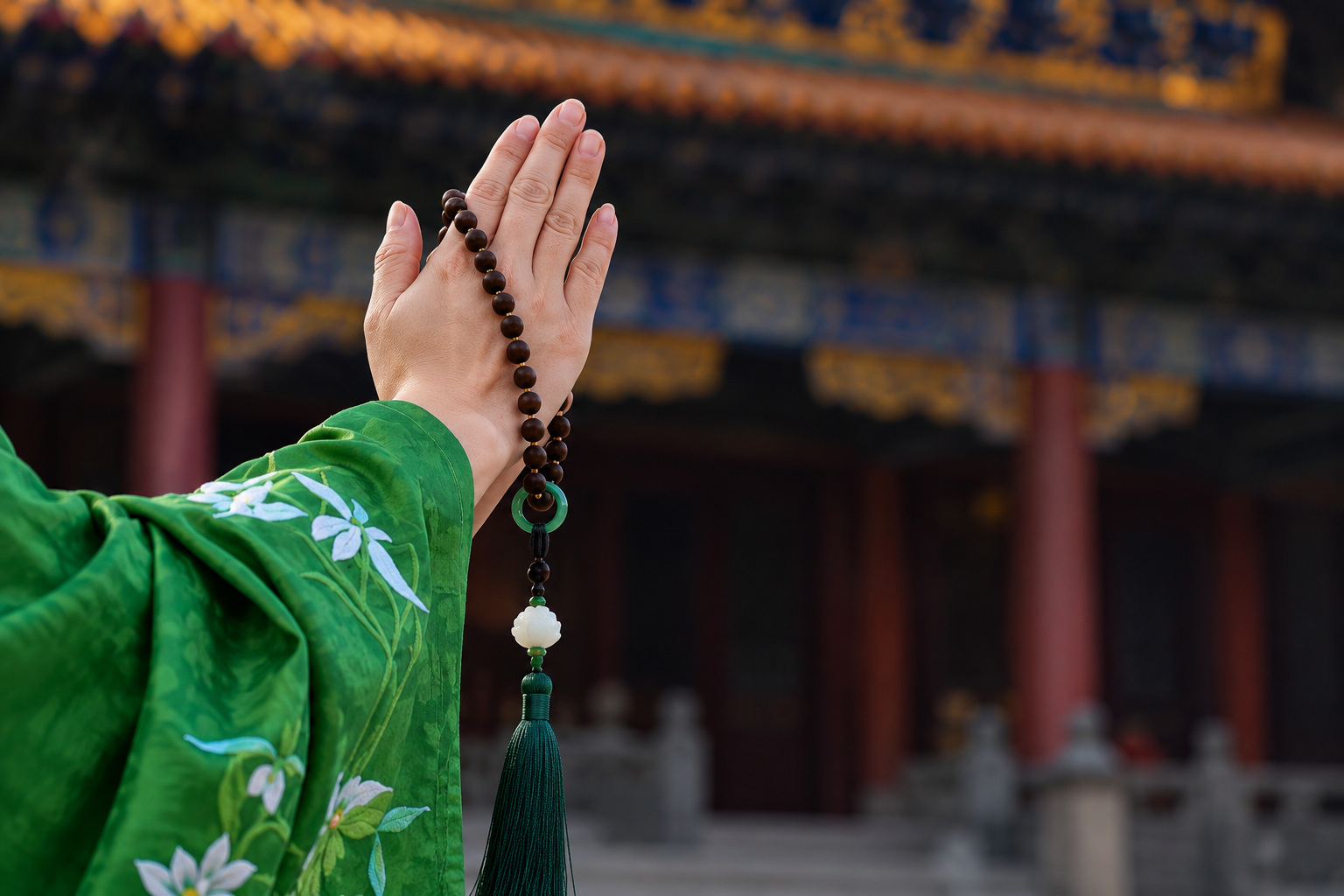
An incense bead is a small pressed botanical object you wear on the body. We mill woods, resins, herbs, and aged peels into a fine powder, balance them by ratio, and hand-roll the mix into 1.2 cm beads. It releases at room temperature at skin-distance — around 30 cm; skin warmth brings it a little further forward rather than switching it on. Clear aroma lasts 6–12 months; a softer trace, much longer. No alcohol. Nothing sprayed.
This guide covers what incense beads are, how they compare with perfume and oil bracelets, why the scent lasts, and how to wear, care for, and choose them.
In one sentence: Incense beads are solid beads pressed from milled plants and a plant binding powder, worn on the body and released at room temperature at near-distance. The clear aroma lasts 6–12 months, with a softer trace long after, and no fragrance is ever added. When it fades, a few days in a sealed bag brings it back.
What Are Incense Beads?
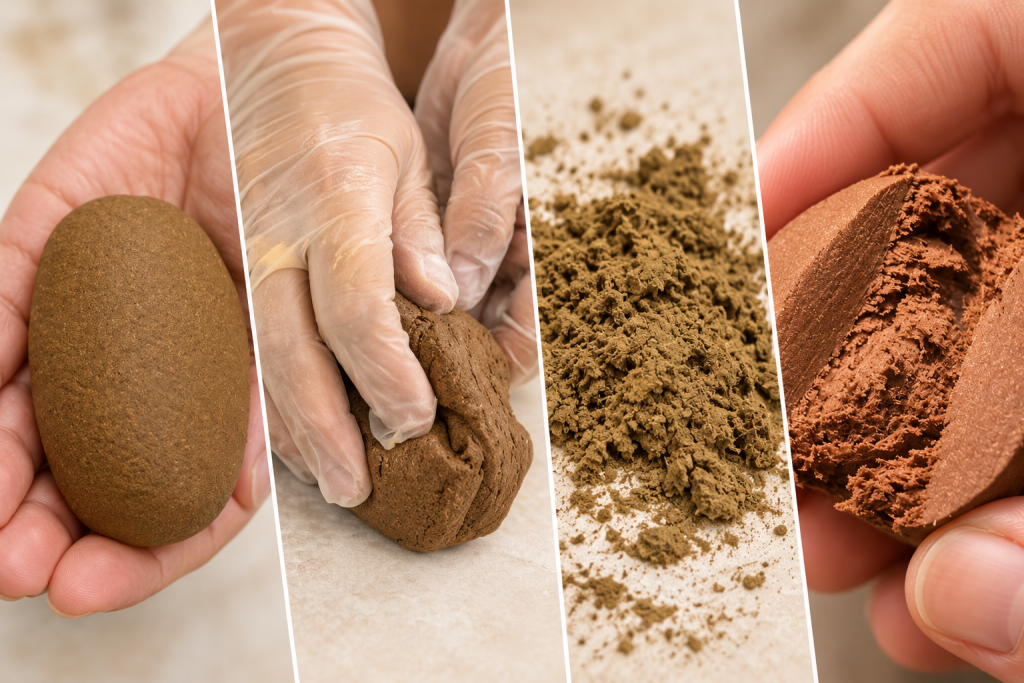
The defining word is compound. An incense bead isn’t one material shaped — it’s a composition. Several plant materials are milled to a 120-mesh powder and balanced by ratio. In one blend, stable aromatic woods form the base, osmanthus or magnolia the middle, balsamic resins help it hold, and aged citrus peel gives the opening lift. Each recipe uses its own mix. The powder is bound with a plant binding powder such as nanmu (Phoebe) or elm and hand-rolled into 1.2 cm beads. The mix then shade-dries for seven days. During that rest, the materials react: woods settle, resins soften, florals retreat. The bead becomes one register, not many. That is what separates a compound bead from a single-wood mala, where one wood carries the whole. The compounded scent tradition this draws on was systematised in the Song dynasty by Hong Chu in his Xiangpu (香譜) — one of the earliest complete documents of the craft.
If you want to see the individual materials we use, our Materials Library lists each one with origin, role, and aroma profile. For the full process, from choosing materials to stringing, see How Are Incense Beads Made?
Incense Beads vs. Perfume — The Real Difference
| Dimension | Perfume | Incense Beads |
|---|---|---|
| Form | Liquid in alcohol | Pressed solid bead |
| Release | Alcohol evaporates outward | Room temperature; body heat, friction and humidity nudge it forward |
| Distance | 1–2 m (a whole room) | Within 30 cm (close to the skin) |
| Duration | 3–8 hours | 6–12 months clear, years softer |
| Structure | Top → heart → base | One register, slow drift |
| How it’s used | Sprayed on skin or clothing | Worn, held, pocketed |
| Materials | Alcohol + essential oils + synthetic compounds | Real botanicals — woods, flowers, herbs, resins, peels |
Perfume is a sentence spoken aloud. Incense beads are a sentence kept inside the sleeve.
Incense Beads vs. Oil Diffuser Bracelets and Wood Malas
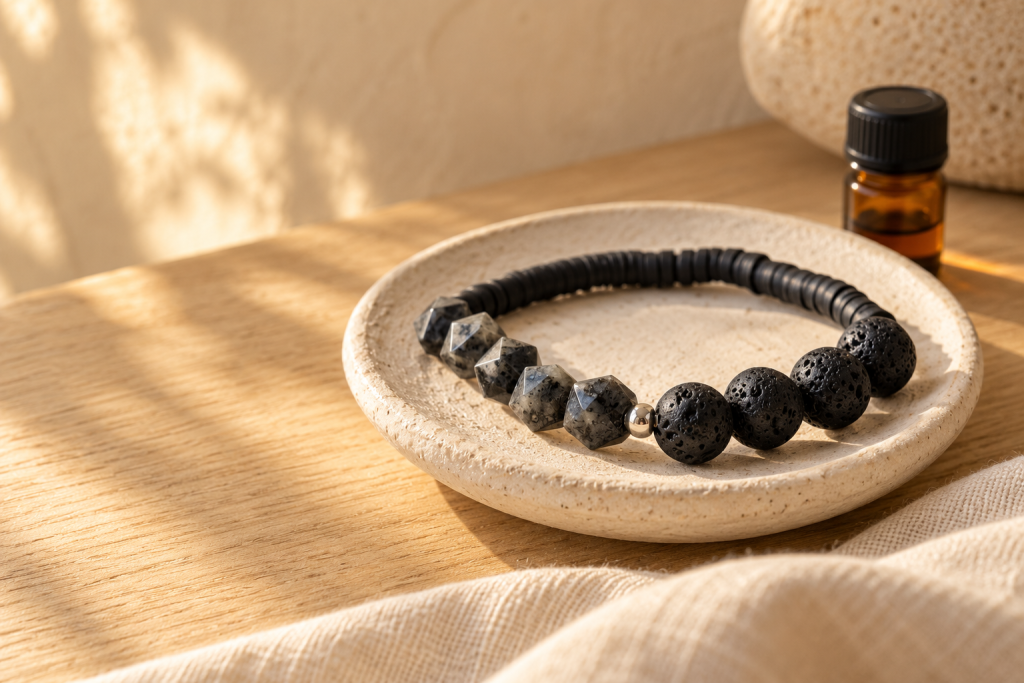
People meeting incense beads for the first time often set them beside two other bracelets: lava stone bracelets you drop essential oil on, often called aromatherapy bracelets, and malas carved from a single wood.
| Lava stone + essential oil | Single-wood mala | Incense beads | |
|---|---|---|---|
| Where the scent comes from | Oil dropped onto porous stone | The wood itself | Several milled plants, pressed into the bead |
| Topping up | Every day or two | Not needed | Not needed |
| What you smell | The single oil you added | One wood note, often faint until warmed | One blended scent |
| How long it lasts | Days | Depends on the wood, often faint | Clear aroma for 6–12 months |
An oil bracelet makes it easy to switch scents, and a wood mala is chosen for the wood itself. With incense beads, the scent is part of the bead. There is nothing to top up.
Where the Scent Comes From
A bead’s character depends on which materials go in and in what ratio. Most come from four families, each with its own job. The ones below are examples, and every blend uses its own mix.
Woods — the structural base
Agarwood, sandalwood, cedar, Jiang Zhen wood. They give the depth, and the long tail. Almost every formula starts here.
Florals — the soft middle
Osmanthus, Chinese rose, magnolia. Lived-in warmth, easy to approach.
Resins — binder and depth
Frankincense and benzoin do two jobs at once. They physically hold the bead together. They also pull the other notes into a single rounded register and stretch the trail.
Citrus and spice — the opening lift
Aged citrus peel, dried mandarin, restrained spices. The first impression. They keep the composition from feeling heavy from the start.
Why the Scent Lasts and How to Bring It Back
The scent comes from the materials themselves. Its aromatic compounds are already in the woods, resins, flowers, and peels. Once these are milled fine and pressed into a bead, the scent can only leave from the surface, a little at a time, so it doesn’t evaporate all at once the way perfume does.
Daily wear, body heat, and friction make it release faster. Strong sun can fade it, and perfume or lotion can change how it smells.
When the scent fades, seal the beads in an airtight bag for three or four days. Leave them longer for a stronger scent.
A Brief History
Carrying scent on the body — sachets, scent pills, beads — goes back to early classical China. By the Tang and Song dynasties, compounding scent had become a formal craft.
- Song dynasty: Hong Chu’s Xiangpu (香譜, “A Treatise on Incense”) systematised the classification of materials, recorded formulas, and described the preparation of compound scent pills — one of the earliest complete documents of the craft.
- Ming–Qing era: Court rosaries (chao zhu) made of high-grade agarwood (伽南香) appeared as ceremonial objects. The Palace Museum in Beijing holds several pieces.
- Today: Incense beads survive as a plant-based alternative to synthetic perfumery — near-distance, durable, slower.
Who Are Incense Beads For?
Not a product for everyone. Specific by design.
A good fit if you
- are drawn to woody, herbal, resinous, or East Asian scent profiles
- find perfume too projecting, too “social”
- care about material honesty — real plants, no alcohol carrier, no synthetic aroma compounds
- prefer scent that unfolds over hours, not minutes
- think of scent as personal company rather than outward signal
- are part of a yoga, pilates, breath-work, or meditation practice and want a worn object that fits the practice
Less of a fit if you
- want a scent that fills a room
- prefer sharp floral or fruity registers that bloom fast and fade
- are sensitive to specific botanicals (resins, pollens, spices)
- work in conditions of constant water contact or heavy washing
How to Wear and Use
| Method | How | What you feel |
|---|---|---|
| On the wrist | As a bracelet, bead count set by wrist size and style | Warmed by body heat; strongest at the inner wrist and palm |
| Held in hand | Picked up between tasks | A small ritual — reading, slow breathing, transitions |
| Tucked in clothing | Inner pocket, coat lining, pouch | An intermittent trace through the day |
| Drawer or bedside | In a closed drawer or beside a pillow | Linen and clothes take on a soft layer of scent |
How to Care for Incense Beads
- Keep them dry and out of strong sun, and keep perfume and lotion off them.
- Washing your hands is fine. Take them off before your hands go into water for long, such as washing dishes or swimming.
- If they get wet, pat them dry and let them air-dry in the shade. Don’t use the sun or a hair dryer.
- In very humid places, a little mold can appear on the surface. White mold wipes off, and the beads are fine to wear. If it’s black, it’s time to replace them.
- You can sleep in them.
- When you’re not wearing them, keep them sealed in a bag or a lidded box. The scent will keep longer.
How to Choose Your Incense Beads
Singular Rose is led by rose, creamy and full. Green Hour pairs lavender with agarwood for a herbal, woody warmth.
Both come in 1.2 cm and 1.4 cm beads.
For the fit, measure the narrowest part of your wrist with a soft tape or a strip of paper and enter the number on the product page. We set the bead count from your wrist size and the style, including any crystals and accents.
To see the actual pieces we make, browse our fragrance jewelry collection.
FAQ
Can I wear incense beads with perfume?
Better to keep them apart. The alcohol in perfume can dissolve the bead’s binder and shift its natural aroma. If you want both, put them on opposite sides — beads on the wrist, perfume behind the ear.
Can I wear incense beads at work or in shared spaces?
Yes. The release distance is about 30 cm, well inside personal space — coworkers, patients, students, or passengers cannot smell it from across a room. Many hospitals, dental offices, airlines, and open-plan workspaces ban projecting perfume. An incense bead is a quiet way to keep a scent ritual without breaching that.
Are incense beads safe for sensitive skin or allergies?
Most reactions come from specific botanicals — frankincense, certain resins, agarwood. If you know you react to those, check the material list before wearing. Our incense beads use only plant binding powder, with no honey.
Can men wear incense beads?
Historically, yes — men and women in classical China wore them equally. Modern compositions read as unisex. The dominant registers (wood, resin, peel) sit closer to traditional men’s perfume territory than to florals.
How do I choose a scent for someone else?
Start with the wood base they already gravitate toward. If they wear sandalwood-heavy perfumes, an osmanthus and sandalwood bead transfers naturally. If they prefer fresh citrus, a peel-led composition. For a first gift, avoid strong resins and dense florals — they tend to divide opinion.
ZendoDream hand-blends botanical scent in small batches of 20, in rural Zhejiang, China.

No-Refill Aromatherapy Bracelet: Incense Beads
Aromatherapy bracelets need refilling every few hours. Incense beads hold the scent inside and stay clear for 6–12…
How to Make Incense by Hand: From Plant Powder to Incense Beads
How to make incense by hand as incense beads: 120-mesh powder, 0.7× water, seven days of shade-drying, real…
Natural Perfume Alternative: Scent You Wear, Not Spray
Natural perfume fades fast and may irritate skin. Here is another way to carry scent: plant beads worn…
The scent behind this story
Singular Rose · Worn
Singular Rose is a rose scented bracelet, with a scent only the people near you will know. Mohong rose, Pingyin rose and roselle carry it, backed by woods and resins, for a creamy, full aroma. Hand-rolled from 120-mesh botanical powder, polished by hand and strung on clear stretch flat cord, with accessories in a choice of styles. Wear it alone or stacked.
Price range: $88.00 through $98.00
View product →