Scent as a small courtesy · Handmade in rural Zhejiang, China

How to Make Incense Pellets: From Plant Powder to a Honey-Kneaded Pellet
How we make incense pellets by hand: 50-mesh powder, honey-kneaded dough, a rest, seven days of shade-drying. Made to be heated, never burned.


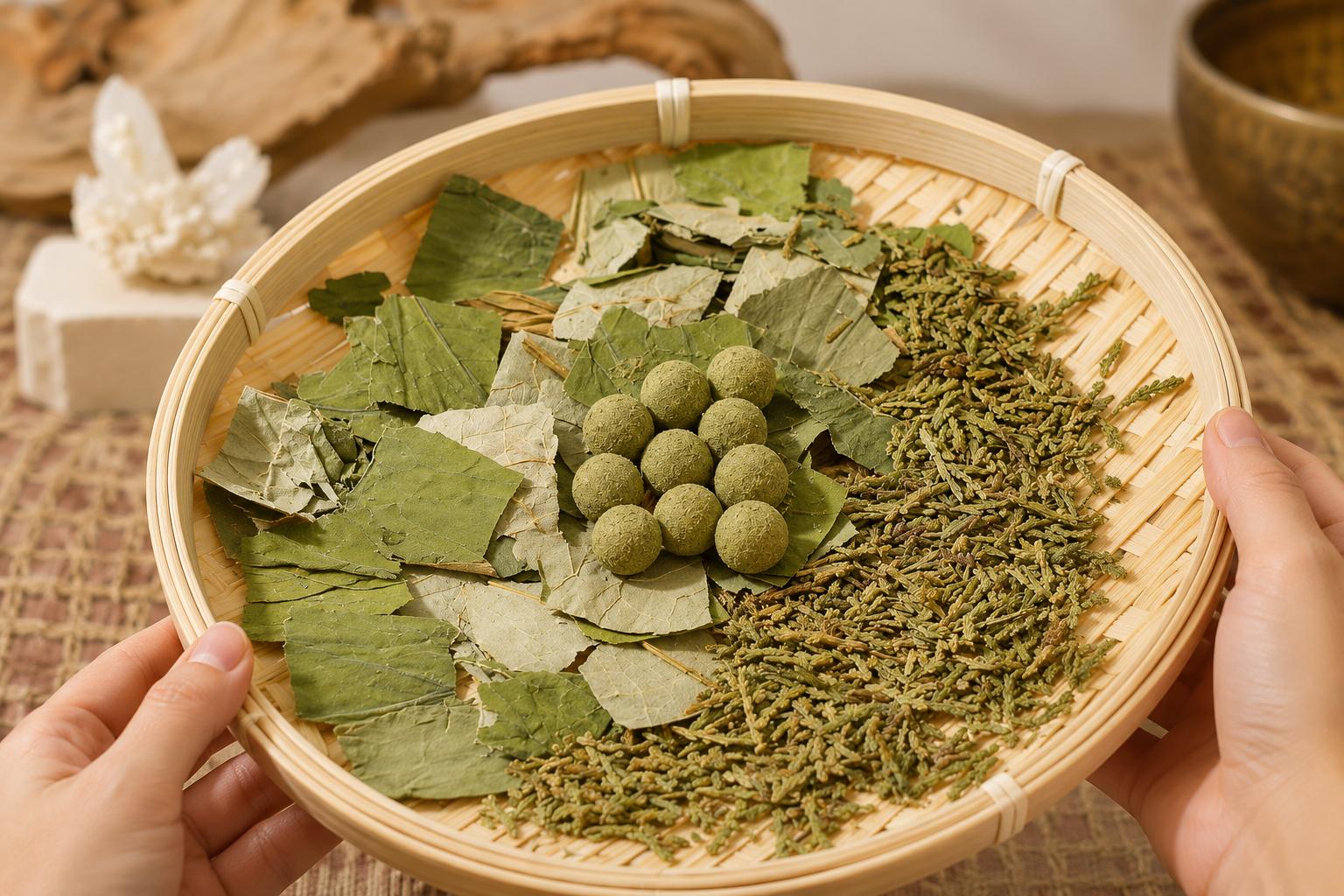
Incense pellets are ground plant materials kneaded with a plant binder and cooked honey, rolled into small balls, coated in powder, shade-dried and sealed in a white porcelain jar. You heat them on a burner instead of lighting them, so there is no smoke and no ash. From preparing the materials to filling the jar takes about 10 days.
Here is each step in order, what we do and why. How incense pellets differ from incense beads comes last. Prefer to watch? How Is Incense Made shows every step for Osmanthus Moon in three and a half minutes.
Choosing the Materials
Pellets are prepared the same way as incense beads at the start, and every recipe uses a group of materials, not just one. They fall into four kinds:
- Flowers: Singular Rose uses two kinds of rose and roselle. Osmanthus Moon uses osmanthus.
- Aromatic woods: sandalwood and agarwood. Slow Heart is led by sandalwood, and its pellets are rolled in sandalwood shavings.
- Resins: benzoin and frankincense in Singular Rose.
- Spices and herbs: clove in Singular Rose and Osmanthus Moon, and lemongrass in Osmanthus Moon.
Grinding and Sifting: Why 50 Mesh
Every material is ground and passed through a 50-mesh sieve. 50 mesh means 50 openings per linear inch of screen, so only particles smaller than about 0.3 mm get through. Incense beads use 120 mesh, about 0.125 mm.
A pellet is made to be used up. It doesn’t need the polish and finish of a bead, so the powder doesn’t have to be fine. It only has to blend with the binder and the honey. Coarse powder blends poorly, and 50 mesh is just right. There is a second reason. When we prepare materials for beads, the part that won’t pass a 120-mesh sieve is about the right size for pellets.
Cooking the Honey
In a honey incense like this, the honey does three jobs. It holds the powder together. It helps the pellets keep for longer. It also adds a layer of honey sweetness to the scent, which makes the whole scent rounder.
Cooking the honey means heating raw honey to drive off its water. A drop on a white plate that holds its shape like a small ball is ready. That is a test Chinese incense makers use. Two kilograms takes about 80 minutes. We cook it in a stainless steel or enamel pot, never a clay one.
Kneading and Resting the Dough
The powder, the plant binder and the cooked honey are kneaded into a dough. How much honey to add is the key to this step. There is no fixed ratio, because it depends on the recipe.
A dough that is slightly dry is better than one that is too wet. If it gets too wet, knead more powder in. We add the honey a little at a time and judge the dough by hand. Then we let it rest for two to three hours.
Rolling the Pellets
We divide the dough into equal portions and roll each one between the palms into a rough ball about 1 cm across. A pellet is meant to be used up, so it doesn’t need to be perfectly round. A Singular Rose pellet weighs about 0.7 to 0.8 g, and a jar holds 35 of them, 26 g ± 1 g in total.
While the pellet is still soft and wet, we coat it with a layer of powder. Each recipe uses its own, such as sandalwood shavings, osmanthus or rose. The coating adds scent and improves the look.
Shade-Drying and Curing
The pellets dry in the shade for 7 days to set their shape. Once dry, they can ship right away. In the half month they spend in transit, they cure, and the scent grows richer.
Why We Don’t Polish
Incense beads are polished until they shine. Incense pellets are made to be used up, so we leave the surface as it is.
Storing the Pellets
The pellets arrive in a white porcelain jar. We suggest using them within 3 months of the order date.
How to Heat Incense Pellets
Heat a pellet on a burner at 150°C / 300°F. Start with one or two, and add more if you want a stronger scent. In a room of about 12 m² / 130 sq ft, a Singular Rose pellet stays rich and full for two to three hours. This is smokeless incense. The pellet is heated and never lit.
Which burner to use is covered in Electric vs Candle Incense Burner for Resin Incense.
How Incense Pellets Differ from Incense Beads
Both turn ground plant materials into small balls, but they are used in opposite ways. Incense beads sit at room temperature and release their scent slowly, and you can wear them on your wrist. Incense pellets are heated, and each one is used up in a session. They are a consumable, stored in a jar.
Japan has a close relative called nerikoh, or kneaded incense. It is also made with honey and heated rather than burned. For how beads are made, see How to Make Incense by Hand.
FAQ
How long does it take to make incense pellets?
About 10 days from preparing the materials to filling the jar, including 7 days of shade-drying.
Why do incense pellets use honey?
Honey holds the powder together and helps the pellets keep. It also adds a layer of sweetness that rounds out the scent.
Do incense pellets need to be cured?
Yes. Once shade-dried, the pellets ship right away. In the half month they spend in transit, they cure and the scent grows richer.
How do you store incense pellets?
Keep them in the white porcelain jar they arrive in. We suggest using them within 3 months of the order date.
What temperature do you heat incense pellets at?
150°C / 300°F. Start with one or two pellets and add more if you want a stronger scent. In a room of about 12 m² / 130 sq ft, a Singular Rose pellet stays rich and full for two to three hours.

What Is Incense? What It Is Made Of, and How to Tell Good Incense
Incense is wood, resin and plants bound into a stick, cone or bead, or a blank stick dipped…
Chinese Tea Culture: Why Tea and Incense Belong Together
Where tea culture comes from, why tea and incense have shared a table since the Song dynasty, and…
How to Choose the Best Incense by Scent: Start With Where You Will Use It
Best incense depends on where you use it. The five scent families, then how to choose for your…
The scent behind this story
Green Hour · Worn
Green Hour is a lavender agarwood bracelet with a scent only the people near you will know — floral and soft, with a gentle woody-herbal warmth. Hand-rolled from 120-mesh botanical powder in the soft olive-green of dried herbs, polished by hand and strung on clear stretch flat cord, with accessories in two styles to choose from. Wear it alone or stacked.
Price range: $88.00 through $98.00
View product →