Scent as a small courtesy · Handmade in rural Zhejiang, China

Roselle (Dried Hibiscus Flowers): The Tart Red Tea Calyx, Its Taste and What Studies Say
Flowers
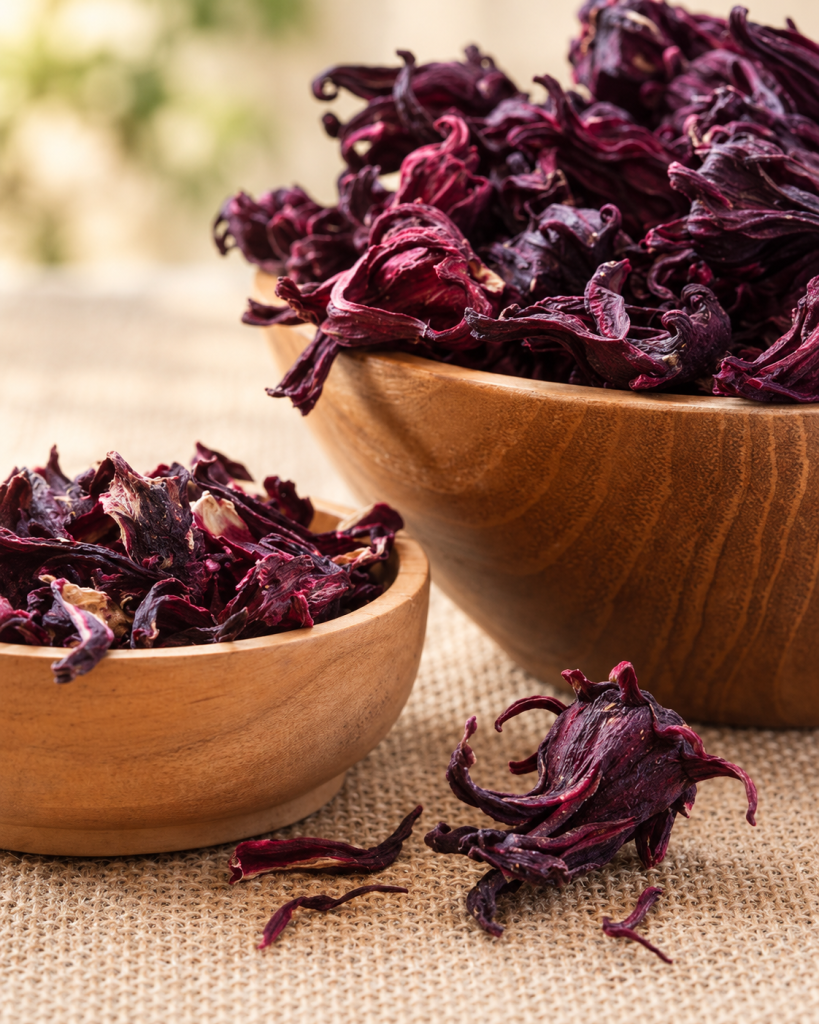
Roselle is the calyx of Hibiscus sabdariffa, a plant in the mallow family. When we say dried roselle, we mean the calyx that swells, thickens and turns deep red after the flower fades, not the yellow-white petals. It steeps into a deep red tea that is tart, a little like cranberry. It goes by many names: karkadé in Egypt and Sudan, zobo in Nigeria, agua de jamaica in Mexico, sorrel in the Caribbean.
| Also known as | Roselle, Hibiscus sabdariffa (some sources now write Sabdariffa gossypiifolia), Jamaica sorrel, rosella, Florida cranberry |
| What it is | An annual or perennial herb in the mallow family. The calyx is the part used |
| Scent | Tart with fruity sweetness, close to caramel once dried |
| Key compounds | Anthocyanins, protocatechuic acid, and flavonoids such as gossypetin |
| Grown in | Probably native to Africa. It reached Asia and the West Indies in the 16th and 17th centuries. China and Thailand grow the most |
| Common forms | Dried calyces, tea, jam, a natural red food dye |
| Protection | A cultivated crop, not listed under CITES |
What is roselle?
Roselle is an herb that grows 2 to 2.5 m tall, with leaves cut into 3 to 5 lobes. The flower is 8 to 10 cm across, white to pale yellow, with a dark red spot at the base of each petal. After the flower fades, the calyx grows from 1 to 2 cm to 3 to 3.5 cm, turns thick and deep crimson over about six months. That calyx is the part we use.
What does roselle taste and smell like?
Tart, with a fruity sweetness, and a deep red that runs close to purple. The usual comparison is cranberry, and the juice is also said to taste a little like grape or cranberry juice. Once dried it turns sweeter and smells close to caramel. The red comes from anthocyanins.
How do you use roselle?
| Way | How | Good for |
|---|---|---|
| As tea | Dried calyces in hot water, with sugar, lemon or orange. Italians often drink it hot | A warm drink |
| As a cold drink | Steep, let it cool, sweeten and chill. Common in Ghana, Nigeria and Senegal | Summer |
| As jam | The fruit has enough pectin to make jam without adding any | The kitchen |
| As a dye | A water-soluble natural red food dye | Sweets |
| In blends | Ground dried calyx, a little in incense beads or sachets, adds a touch of fruity tartness and red | Carried with you |
How is roselle different from other materials?
Often confused: roselle, “hibiscus” and ornamental hibiscus
In English, hibiscus tea means roselle tea, made from the calyx of Hibiscus sabdariffa. The big red-flowered ornamental hibiscus in gardens and along roads, such as Hibiscus rosa-sinensis, is a different plant.
| Name | What it is |
|---|---|
| Roselle, the dried flowers in hibiscus tea | The calyx of Hibiscus sabdariffa |
| Ornamental hibiscus | Another hibiscus plant, not used for this tea |
| Nigerian zobo | Usually made from the calyx, though some versions use dried leaves |
Where does roselle come from?
Probably Africa. It reached Asia and the West Indies in the late 16th and early 17th centuries. China and Thailand now grow the most and control much of the world supply. Sudan, Nigeria, Mexico, Egypt, Senegal, Tanzania, Mali and Jamaica also grow a lot, though much of it is drunk at home.
How it is eaten varies. In Burmese cooking the leaves are fried with prawns, garlic and chili. In the Philippines, leaves and flowers add sourness to tinola chicken soup. In Vietnam, young leaves, stems and fruit go into fish and eel soups. In Ghana it is sobolo, in Senegal and Burkina Faso bissap, in Thailand krachiap.
What are the benefits of roselle?
Below, each claim says who made it. Blood pressure is the most studied topic, and the answer is still unsettled.
| Claim | Evidence | What was found |
|---|---|---|
| Lowers blood pressure (as tea) | Human study (meta-analysis) | 2022, Nutrition Reviews: 17 randomized trials, 415 people on roselle and 404 controls. Against placebo, other tea or diet, systolic pressure fell by 7.1 mmHg on average (95% interval -13.0 to -1.2). Diastolic pressure showed no clear difference. The trials varied widely (I² 95%), and most were small and short, 4 to 12 weeks. The authors call for more studies |
| Lowers blood pressure (as tea) | Human study (systematic review) | 2021 Cochrane review: only 1 trial qualified, 60 adults with type 2 diabetes and high blood pressure, over 8 weeks. The certainty of the evidence was “very low,” and the review concluded the evidence is not enough to say whether roselle lowers blood pressure. The trial did not report withdrawals from side effects, so it cannot say whether roselle is safe either |
Roselle in history and culture
One red drink, three continents
Karkadé in Egypt and Sudan is drunk hot or cold. Agua fresca in Mexico, Central America and Colombia is iced. Caribbean sorrel is sweetened and spiced with bay leaf, clove and ginger. In Italy it is carcadè, often served hot with sugar, lemon or orange.
Where the red comes from
Roselle’s red dissolves in water, so it works as a natural food dye. The color is tied to its anthocyanins and flavonoids.
Is roselle safe?
As food and tea, roselle is widely eaten, and the studies reported no serious problems. A few things to keep in mind:
- Blood pressure. Studies saw systolic pressure fall. If your blood pressure is already low, or you take blood pressure medication, ask a doctor first.
- Pregnancy. We found no authoritative source that settles it, so ask a doctor before drinking it while pregnant.
- Ask a doctor before using it as medicine, especially if you are pregnant, breastfeeding or taking medication.
Roselle at ZendoDream
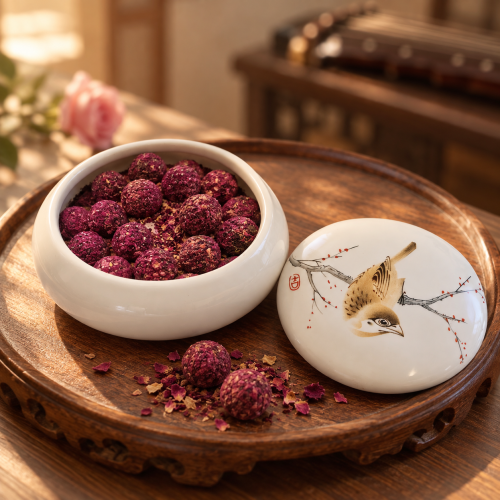
Roselle is quite sour, with a trace of rose-like sweetness. It is a natural, bright purple-red, and in blending we mostly use it to color the beads. Too much turns the scent sour, so we add it sparingly. That faint sourness gives the scent another layer and a little movement. Roselle with Mohong rose is a common pairing in incense beads.
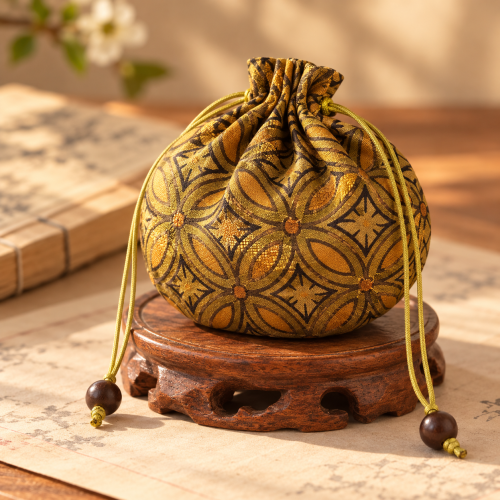
Roselle is one of the botanicals in the sachet of Singular Rose · Carried: the sweetness of rose, with a light tartness from roselle and the cool of mint. It sits in silk gauze, carried with you. It is not heated or burned.
Pieces made with roselle
-

Singular Rose · Carried
$58.00 -
Singular Rose · Heated
$68.00 -
Singular Rose · Worn
Price range: $88.00 through $98.00Select options This product has multiple variants. The options may be chosen on the product page
FAQ
What is roselle?
The calyx of Hibiscus sabdariffa. It swells, thickens and turns deep red after the flower fades, and is dried for tea, jam and dye.
Are roselle and hibiscus the same?
In English, hibiscus tea means roselle tea. The big red-flowered ornamental hibiscus along roads and in gardens is a different plant.
What does roselle tea taste like?
Tart with fruity sweetness, deep red, often compared to cranberry. Dried, it turns sweeter and smells close to caramel.
What are the benefits of roselle tea?
Blood pressure is the most studied. A 2022 analysis of 17 trials found systolic pressure fell by 7.1 mmHg on average, but the trials varied widely. A 2021 Cochrane review found the evidence not enough to decide.
How do you make roselle tea?
Steep dried calyces in hot water, with sugar, lemon or orange. Drink it hot, or let it cool and chill it.
Can you drink roselle tea while pregnant?
We found no authoritative source that settles it. Ask a doctor first.
Does roselle lower blood pressure?
The studies disagree. A pooled analysis saw systolic pressure fall on average, and a Cochrane review found the evidence not enough to decide. If you take blood pressure medication or your pressure runs low, ask a doctor first.
Sources
- Roselle (plant), Wikipedia)
- Hibiscus tea, Wikipedia
- Ellis et al., 2022, Nutrition Reviews, Hibiscus sabdariffa and blood pressure meta-analysis
- Pattanittum et al., 2021, Cochrane Database of Systematic Reviews, Roselle for hypertension in adults
This page is for general education. Health claims from traditional use and studies are not medical advice.