Scent as a small courtesy · Handmade in rural Zhejiang, China

Buddha’s Hand: The Fingered Citron, How It Smells and How the Fruit Is Used
Citrus & Peels
Buddha’s hand is a citron, Citrus medica var. sarcodactylis, also called fingered citron or sold as goblin fingers. The fruit is not round. It splits into long, thin “fingers” like a hand. There is hardly any flesh, mostly white pith, and it smells wonderful, so it is used to scent rooms and clothes, set out as an offering, grated into dishes and made into candied fruit.
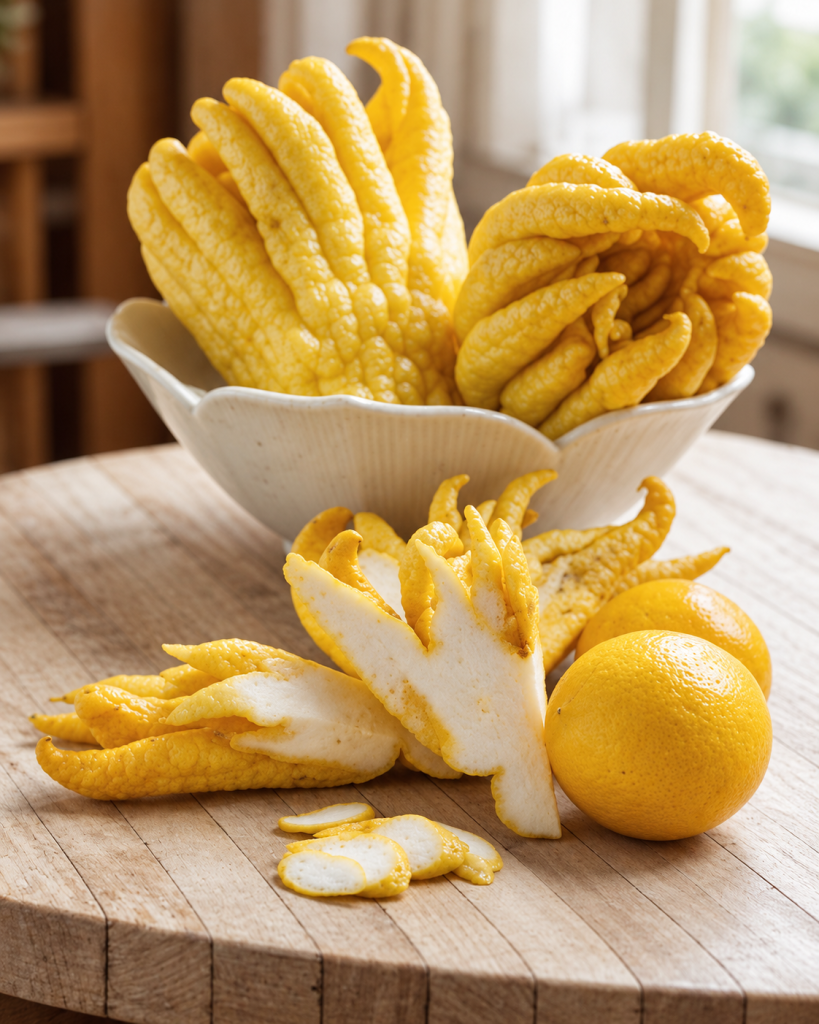
| Also known as | Buddha’s hand, fingered citron, goblin fingers (US Halloween name), Citrus medica var. sarcodactylis |
| What it is | A citron variety in the citrus family. The fruit is used, sliced and dried or zested |
| Scent | Fresh citrus, faintly sweet, lightly bitter |
| Key compounds | Limonene is about 76% and gamma-terpinene about 15 to 17% of the volatiles in fresh rind |
| Grown in | Generally traced to South or East Asia, probably northeastern India or China. Ours comes from China |
| Common forms | Fresh fruit, dried slices, candied fruit, zest, scent use |
| Protection | A cultivated crop, not listed under CITES |
What is Buddha’s hand?
It is a thorny shrub or small tree with large, oblong, pale green leaves and fragrant clusters of white flowers tinted purple on the outside. The “fingers” are mostly white pith. Some hold a little acidic pulp, many are juiceless, and some are seedless. The fruit comes in “open-hand” and “closed-hand” forms, depending on whether the fingers spread or curl in.
It dislikes frost, intense heat and drought, and grows best in a mild climate. It is propagated from cuttings of 2 to 4 year old branches, or grafted onto rootstock, and is prone to citrus greening disease.
What does Buddha’s hand smell like?
Fresh citrus, faintly sweet, with a light bitterness. It is not the mellow, aged warmth of chenpi.
In 2022 Italian researchers measured the volatiles of one Buddha’s hand fruit with headspace sampling and gas chromatography. In fresh rind, limonene made up about 76% (75.8% in the outer rind, 76.2% in the inner), and gamma-terpinene about 15 to 17%. In the distilled essential oil, limonene was 66.9% and gamma-terpinene 20.0%. The water left from distilling, the hydrolate, was mostly alpha-terpineol (44.7%) and terpinen-4-ol (21.6%), with only 3.2% limonene. Limonene is the most common scent molecule in citrus peel.
How do you use Buddha’s hand?
| Way | How | Good for |
|---|---|---|
| As scent | A whole fruit on a desk or in a wardrobe. China and Japan have long used it to scent rooms and clothes | The home |
| In cooking | Zest grated as flavoring in desserts and savory dishes, or steeped in vodka or rice liquor | The kitchen |
| As candied fruit | Sliced and cooked in sugar | Sweets |
| As an offering or gift | An offering in Buddhist temples and a New Year gift in China | Festivals |
| In blends | Sliced, dried and ground, a little in incense beads or sachets adds a fresh citrus note to woods and flowers | Carried with you |
There is almost no flesh, so do not peel and eat it like an ordinary citrus.
How is Buddha’s hand different from other materials?
Often confused: Buddha’s hand vs chenpi
| Buddha’s hand | Chenpi | |
|---|---|---|
| What it is | A citron variety whose whole fruit splits into fingers | The peel of mandarin, dried and aged for years |
| Botanical name | Citrus medica var. sarcodactylis | Citrus reticulata and others |
| Scent | Fresh citrus, faintly sweet and bitter | Mellow, warm citrus that deepens with age |
| How we use it | Dried slices | Dried peel |
For more on chenpi, see our Aged Tangerine Peel page.
Where does Buddha’s hand come from?
It is generally traced to South or East Asia, probably northeastern India or China. It is grown mainly for ornament and scent, and is common in gardens and pots. In the US, unripe fruits have been sold as Halloween decorations under the name “goblin fingers.”
What are the benefits of Buddha’s hand?
Traditionally the dried slices have been used as medicine. Modern research is so far mostly in the lab. Below, each claim says who made it.
| Claim | Evidence | What was found |
|---|---|---|
| A tonic (unripe fruit, dried slices) | Traditional use | Wikipedia says the sliced, dried peel of immature fruit is prescribed as a tonic, without naming a medical system |
| Traditional Chinese medicine profile | Traditional use | A reference site lists the smell as aromatic and the taste as slightly sweet, then bitter, with antiasthmatic, antispasmodic and anti-inflammatory actions (an educational site, not the pharmacopoeia itself) |
| Antioxidant | Lab | 2022 Italian study: methanol extracts of the outer and inner rind and the essential oil scavenged free radicals (about 52 to 56% by the ABTS method). The hydrolate did almost nothing |
| Antibacterial | Lab | Same study: the oil’s minimum inhibitory concentration against Bacillus cereus was 0.5% by volume. Against E. coli, only the extracts worked |
| Kills leukemia cells | Lab (cells) | Same study: against HL60 cells, the oil’s EC50 was 1.24% by volume. The authors call these first-screening results, not a treatment |
These are test-tube results. There are no human trials.
Buddha’s hand in history and culture
A lucky fruit
In China it stands for happiness, long life and good fortune. Legend says the Buddha prefers the fingers closed, because a closed hand means prayer, so temples mostly set out the closed-hand form.
A room full of scent
China and Japan have long used Buddha’s hand to scent rooms and clothing.
Is Buddha’s hand safe?
It has long been used for scent and flavoring. We found no authoritative safety data for the rind. A few things to keep in mind:
- Use it for scent and flavor. It has almost no flesh, so do not eat it in quantity as fruit.
- The extract contains a coumarin. The 2022 study found 5,7-dimethoxycoumarin in the outer rind extract (50.6% of the extract). The study did not discuss coumarins and skin sensitivity to sunlight, and we found no conclusion on that for this rind.
- Ask a doctor before using it as medicine, especially if you are pregnant, breastfeeding or taking medication.
Buddha’s hand at ZendoDream
We use dried slices of Buddha’s hand. They are milder than the cool scent of citrus peel, with a touch of bitterness. In China, many people know the fresh fruit better. They set it in the living room or bedroom as a natural room scent, and one fruit stays fragrant for about a month. Dried Buddha’s hand can be steeped as tea, and incense makers also roll it into incense balls to scent rooms in autumn and winter.
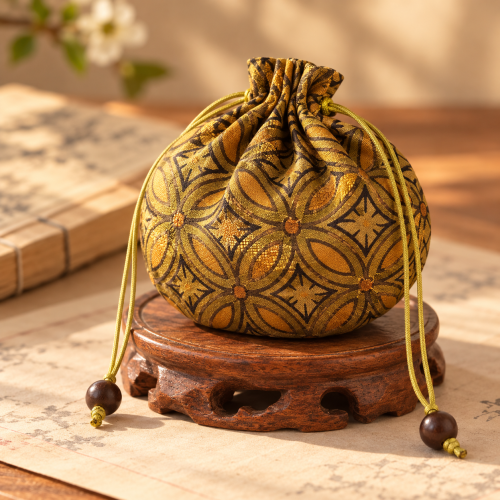
Buddha’s hand and chenpi are the two peels in the sachet of Singular Rose · Carried: the sweetness of rose, a light tartness from roselle, and the cool of mint. It sits in silk gauze, carried with you. It is not heated or burned.
Pieces made with Buddha’s hand
FAQ
What is Buddha’s hand?
A variety of citron, Citrus medica var. sarcodactylis. The fruit splits into finger shapes and has almost no flesh.
What does Buddha’s hand smell like?
Fresh citrus, faintly sweet, with a light bitterness. Limonene is about 76% of the volatiles in fresh rind.
Can you eat Buddha’s hand?
You can grate the rind as flavoring, make it into candied fruit, or steep it in vodka or rice liquor. It has almost no flesh, so it is not eaten like fruit.
Why is it called Buddha’s hand?
Because the fruit splits into fingers like a hand. Legend says the Buddha prefers the closed-hand form, since a closed hand means prayer.
Are Buddha’s hand and chenpi the same?
No. Buddha’s hand is a citron variety whose whole fruit splits into fingers. Chenpi is mandarin peel, dried and aged for years.
What are the benefits of Buddha’s hand?
Traditionally the dried slices are used as medicine. Modern research is only in the lab, with no human trials.
Why is Buddha’s hand called goblin fingers?
In the US, unripe fruits have been sold as Halloween decorations under that name. The long, thin fingers give it the look.
Sources
- Buddha’s hand, Wikipedia
- Vitalini et al., 2022, Molecules, volatiles and biological effects of Buddha’s hand fruit
- Foshou (Buddha’s Hand), Chinese herb reference
This page is for general education. Health claims from traditional use and studies are not medical advice.