Scent as a small courtesy · Handmade in rural Zhejiang, China

Dried Mint Leaves: Peppermint vs Spearmint, Mint Tea and How Mint Smells
Herbs & Leaves
Mint is an herb of the genus Mentha in the mint family. The genus has 18 to 24 species, the boundaries between them are unclear, and they hybridize freely, so there are many hybrids and cultivars. Dried mint leaves are leaves dried in sun or shade, used for tea, flavoring and incense. They smell cool and fresh, with a clear menthol note.
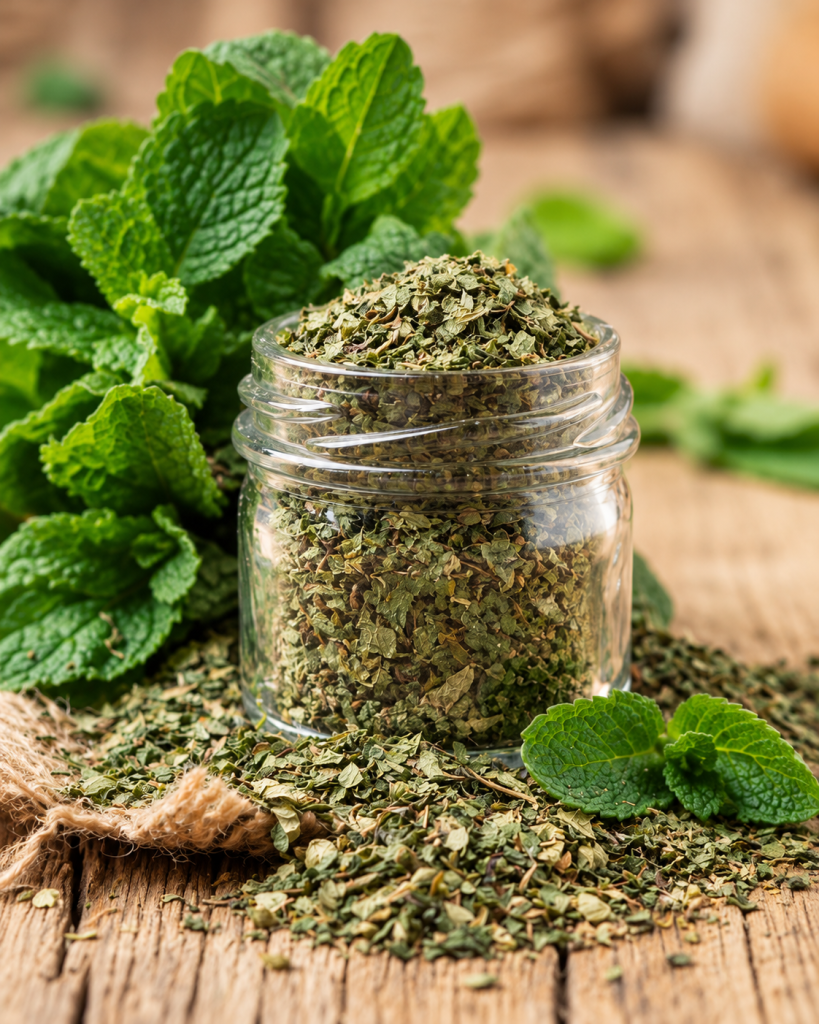
| Also known as | Mint, peppermint (Mentha × piperita), spearmint (Mentha spicata), and the pharmacopoeia’s bohe (Mentha haplocalyx Briq.) |
| What it is | The leaves of a perennial aromatic herb that spreads by runners |
| Scent | Cool and fresh with a clear menthol note. Spearmint is sweeter and spicier |
| Key compounds | Peppermint: menthol and menthone. Spearmint: L-carvone |
| Grown in | Worldwide, mostly in damp places. Ours comes from China |
| Common forms | Fresh leaf, dried leaf, tea, essential oil, menthol |
| Protection | A cultivated crop, not listed under CITES |
What is mint?
Mints usually grow 10 to 120 cm tall, spread by stems that run along the ground, and like wet soil. The genus name comes from the Greek míntha, and in Greek myth Minthe was a nymph.
The most common commercial mints are peppermint, spearmint, Scotch spearmint (Mentha × gracilis) and cornmint (Mentha arvensis).
In China, bohe in the pharmacopoeia means the aerial parts of Mentha haplocalyx, harvested in summer and autumn and dried in sun or shade. But one study found that the Japanese and Chinese pharmacopoeias use the same characters for different source plants, and that the DNA of Chinese market samples all matched Mentha canadensis. Menthol content varied widely between samples, and menthol was not always the main compound. So ask what species you are buying.
What does mint smell like?
Cool and fresh, with a clear menthol note. Different mints get their scent from different molecules.
| Mint | Main molecules | Smells |
|---|---|---|
| Peppermint | Menthol (about 41% of the oil) and menthone (about 23%) | The coolest and sharpest |
| Spearmint | L-carvone, with very little menthol | Cool with sweetness and spice, a milder chill than peppermint |
| Cornmint, Japanese mint | Menthol | Strongly cool, the main source of natural menthol |
In dried peppermint, menthol is 7 to 48% of the volatile oil, a wide range. In mint oil, menthol can reach 40 to 90%.
How do you use mint?
| Way | How | Good for |
|---|---|---|
| As tea | Fresh or dried leaves in hot water, alone or with green tea. Moroccan mint tea uses spearmint with green tea | A warm drink |
| In cooking | Mint sauce in Britain, mint jelly in the US, and common in Indian and Middle Eastern cooking. Cocktails include the mojito and the mint julep | The kitchen, drinks |
| For fresh breath | Mint oil and menthol flavor toothpaste, mouth rinse, gum and candy | Daily use |
| Against pests | Mint oil is used as a gentler insecticide against wasps, ants and cockroaches | The home |
| In blends | Ground dried leaf, a little in incense beads or sachets adds a cool note to woods and flowers | Carried with you |
How is mint different from other materials?
Kinds: peppermint vs spearmint
| Peppermint | Spearmint | |
|---|---|---|
| Botanical name | Mentha × piperita | Mentha spicata |
| Origin | A hybrid of water mint (M. aquatica) and spearmint | The type species of the genus, probably from M. longifolia and M. suaveolens after chromosome doubling |
| Main scent molecules | Menthol, menthone | L-carvone |
| Taste | Strong chill, sharp | Cool with sweetness, a milder chill |
| Common use | Mint tea, toothpaste, candy, peppermint oil capsules | Spearmint tea, Moroccan mint tea, mojitos, gum |
Peppermint was first published in 1696 by the English naturalist John Ray and was added to the London Pharmacopoeia in 1721. Spearmint is mentioned as early as the 1st century AD, and the Romans brought it to England by the 5th century.
Often confused: the word “mint”
In Chinese, bohe can mean peppermint, spearmint, or the pharmacopoeia’s Mentha haplocalyx. In English, “mint” is also the name of a candy and of a personal finance app. This page is about mint as a leafy herb.
Where does mint come from?
The genus grows around the world and does best in damp places. Spearmint is native to Europe and temperate Asia as far as southern China. Peppermint is a cultivated hybrid. World production in 2023 was about 35,500 tonnes, around 78% from Morocco and about 20% from Argentina. In the US, most peppermint is grown in Oregon and Washington.
What are the benefits of mint?
Ancient Greece, Rome and Egypt used mint for digestive trouble. The US National Center for Complementary and Integrative Health (NCCIH) says there is not enough evidence to say whether peppermint leaf helps any health condition. Most of the research is on enteric-coated peppermint oil capsules, not on leaves steeped as tea. Below, each claim says who made it.
| Claim | Evidence | What was found |
|---|---|---|
| Eases abdominal pain in irritable bowel syndrome (IBS) | Human study (meta-analysis) | 2019: 12 randomized trials, 835 adults. Enteric-coated peppermint oil improved overall symptoms (risk ratio 2.39, 95% interval 1.93 to 2.97) and abdominal pain (1.78, 1.43 to 2.20). Side effects did not differ significantly from placebo, with heartburn the most reported. The authors rated that evidence as low quality |
| Eases IBS symptoms | Human study (meta-analysis) | 2022 review: 10 studies, 1,030 people. Enteric-coated peppermint oil beat placebo but caused more side effects, mostly mild acid reflux and indigestion. A 2021 American College of Gastroenterology guideline recommends it for overall IBS symptoms |
| Eases chemotherapy nausea | Human study (small) | NCCIH says a small amount of research exists. In a 2024 review of 10 aromatherapy studies, 4 used peppermint oil (290 people), and inhaling worked especially well |
| Eases tension headache (on the skin) | Human study (limited) | NCCIH: the evidence is limited |
| Indigestion | None | NCCIH: peppermint oil alone has no supporting evidence, and in some people it makes indigestion worse |
For peppermint leaf steeped as tea, NCCIH’s conclusion is that the evidence is not enough. The long-term safety of large amounts of leaf is unknown.
Mint in history and culture
Mint in Greek myth
The Greeks saw mint as a symbol of hospitality. They are said to have rubbed it on their arms, believing it would make them stronger.
An herb strewn on the floor
Early Europeans strewed mint on floors to mask the smell of hard-packed earth, one of the first room deodorizers.
Tax-free tea in the American Revolution
Spearmint was an important cash crop in Connecticut during the American Revolution, when untaxed mint tea was popular.
Is mint safe?
As food and tea, mint is considered safe. A few things to keep in mind:
- Infants and young children. Menthol can affect breathing. Do not let them inhale it or put it on their faces (NCCIH).
- Heartburn and reflux. Peppermint oil taken by mouth often causes heartburn, nausea, stomach pain and dry mouth.
- Allergy. Some people react, with cramps, diarrhea, headache, heartburn, tingling or numbness in the mouth, contact dermatitis, and in severe cases anaphylaxis (Wikipedia).
- Medication. Taken by mouth it may interact with iron supplements, cyclosporine, heart and blood pressure medicines, and acid reducers (Wikipedia).
- Pets. The ASPCA lists mint as toxic to dogs, cats and horses. The toxic part is its essential oil, and large amounts bring vomiting and diarrhea.
- Ask a doctor before using it as medicine, especially if you are pregnant, breastfeeding or taking medication. The amounts in food are generally considered safe, and medicinal amounts are not well studied.
Mint at ZendoDream
Mint feels more piercing than lemongrass. It opens the nose, and the cool travels in through the nostrils up to the front of the head.
In summer we sometimes make cooling mint incense balls. Fresh mint goes in with green grape skins and rosemary, on a base of agarwood and sandalwood.
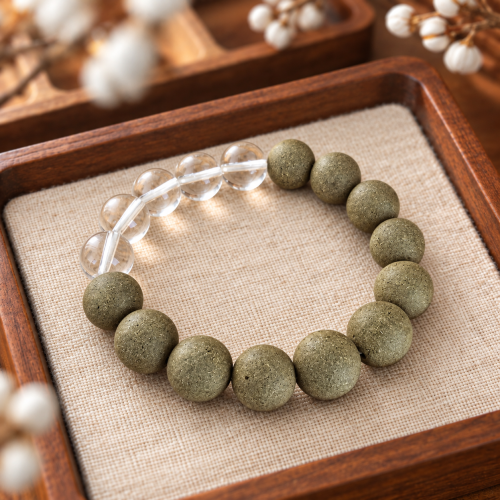
Mint is one of the herbs in Green Hour · Worn: the floral note of lavender and the coolness of mint and lemongrass, softened by agarwood, with a gentle woody-herbal warmth. The beads are hand-rolled in the soft olive-green of dried herbs.
Pieces made with mint
-

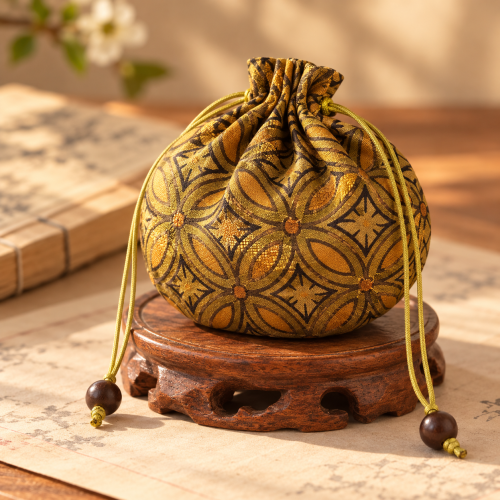
Singular Rose · Carried
$58.00 -
Green Hour · Worn
Price range: $88.00 through $98.00Select options This product has multiple variants. The options may be chosen on the product page
FAQ
What does mint smell like?
Cool and fresh, with a clear menthol note. Peppermint is the coolest. Spearmint is sweeter and spicier, with a milder chill.
What is the difference between peppermint and spearmint?
Peppermint is a hybrid of water mint and spearmint. Its scent comes mainly from menthol and menthone, so it chills strongly. Spearmint’s scent comes mainly from L-carvone, with almost no menthol, so it is cool with sweetness.
How do you make tea from dried mint leaves?
Steep dried leaves in hot water, alone or with green tea. Moroccan mint tea uses spearmint with green tea.
What are the benefits of mint tea?
The ancient Mediterranean world used mint for digestive trouble. NCCIH says there is not enough evidence on whether peppermint leaf helps any condition. The better-studied form is enteric-coated peppermint oil capsules, which help with IBS abdominal pain, though heartburn is common.
Is mint safe for cats and dogs?
No. The ASPCA lists mint as toxic to dogs, cats and horses. The toxic part is its essential oil, and large amounts bring vomiting and diarrhea.
Can babies smell mint?
No. Menthol can affect breathing. NCCIH says not to let infants and young children inhale it or to put it on their faces.
Can you put dried mint in incense?
Yes. Ground dried leaf, a little in incense beads or sachets, adds a cool note to woods and flowers.
Sources
- Mentha, Wikipedia
- Peppermint, Wikipedia
- Spearmint, Wikipedia
- Peppermint Oil, NCCIH
- Alammar et al., 2019, BMC Complementary and Alternative Medicine, peppermint oil and irritable bowel syndrome
- ASPCA: Mint (toxic to dogs, cats and horses)
- Journal of Natural Medicines, 2024, source plants of Chinese and Japanese mint
This page is for general education. Health claims from traditional use and studies are not medical advice.