Scent as a small courtesy · Handmade in rural Zhejiang, China

Lemongrass: How It Smells, Lemongrass Tea, and How It Differs From Citronella
Herbs & Leaves
Lemongrass is a lemon-scented tropical grass, Cymbopogon citratus. It smells like lemon but has none of the sourness. Southeast Asian cooking relies on it, and the dried leaves are often brewed as tea. The scent is bright and lemony, with a green, grassy note underneath.
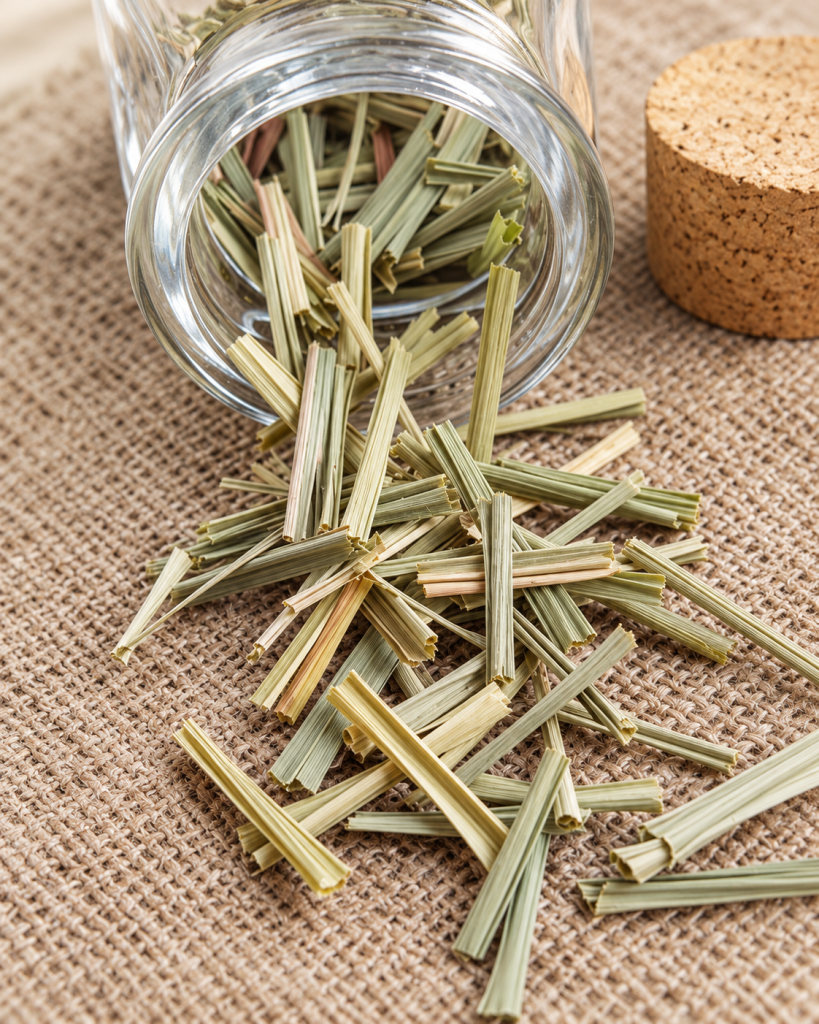
| Also known as | Lemon grass, West Indian lemongrass, Cymbopogon citratus. A close relative is East Indian lemongrass, Cymbopogon flexuosus |
| What it is | The stalks and leaves of a grass in the genus Cymbopogon |
| Scent | Bright lemon with a grassy edge and a little sweetness |
| Key compounds | Citral makes up 65 to 85% of the oil. It also contains myrcene, citronellal, linalool and geraniol |
| Grown in | Native to South Asia and maritime Southeast Asia, now grown across the tropics and subtropics. Ours comes from Yunnan and Guangdong in China |
| Common forms | Fresh stalks, dried cut pieces, essential oil, tea |
| Protection | A cultivated crop, not listed under CITES |
What is lemongrass?
The genus Cymbopogon has 52 species, all grasses. Lemongrass has long, narrow, bluish-green leaves, 45 to 90 cm long. It rarely flowers or sets seed, so it is grown by dividing clumps. A mature clump has 50 to 200 shoots. It likes full sun and 25 to 30°C, cannot take frost, and may die after long spells below 10°C.
The name Cymbopogon comes from the Greek for boat and beard, because the hairy spikelets stick out of boat-shaped sheaths.
What does lemongrass smell like?
Bright lemon, with a grassy edge and a little sweetness underneath. The lemon note comes mostly from citral, which makes up 65 to 85% of lemongrass oil. Citral has a strong lemon smell of its own and is widely used in perfume and food to boost a lemon note.
How do you use lemongrass?
| Way | How | Good for |
|---|---|---|
| In cooking | Fresh stalks sliced thin or bruised, for tom yum, tom kha kai, roast chicken and Filipino lechon | The kitchen |
| As tea | Dried leaves steeped alone or added to other teas. It tastes like lemon juice with a mild sweetness, without the sourness | A warm drink |
| As essential oil | Added to soap, lotion and diffusers | Skincare, the home |
| In blends | A little in incense beads or sachets adds a bright lemon note to woods | Carried with you |
How is lemongrass different from other materials?
Kinds: West Indian vs East Indian lemongrass
| West Indian lemongrass | East Indian lemongrass | |
|---|---|---|
| Botanical name | Cymbopogon citratus | Cymbopogon flexuosus |
| Native to | Maritime Southeast Asia | India, Sri Lanka, Myanmar, Thailand, Cambodia, Vietnam, Laos |
| Other names | Lemongrass, lemon grass | Cochin grass, Malabar grass |
| Common use | Better for cooking | Mostly distilled for oil |
The two can be used in place of each other.
Often confused: lemongrass vs citronella
In Chinese both are often called by the same name, but they are different plants in the same genus.
| Lemongrass | Citronella grass | |
|---|---|---|
| Botanical name | Cymbopogon citratus | Cymbopogon nardus, Cymbopogon winterianus |
| Looks | Bluish-green leaves | About 2 m tall, with magenta stem bases |
| Main compounds in the oil | Citral | Citronellal, geraniol |
| Common use | Cooking, tea | Citronella oil for insect sprays, soap and candles |
Where does lemongrass come from?
Lemongrass is native to South Asia and maritime Southeast Asia. After the First World War it was taken to Madagascar, South America and Central America, and it now grows throughout the tropics and subtropics. In Indonesia and Malaysia it is called serai or sereh, in the Philippines tanglad, and in Thailand takhrai. The world makes about 4,000 tonnes of citronella oil a year, and China and Indonesia produce 40% of it.
What are the benefits of lemongrass?
In Brazilian folk medicine lemongrass tea is drunk to calm the nerves. Traditional medicine in India uses the leaves to bring on sweating and lower fever. Modern research includes a few small human trials, and the results are mixed. Below, each claim says who made it.
| Claim | Evidence | What was found |
|---|---|---|
| Calm and sleep (as tea) | Human study | A 1986 Brazilian study: 50 volunteers took lemongrass tea or a placebo under double-blind conditions, and their sleep did not differ. 18 people with high anxiety took an anxiety test, and their scores did not differ either |
| Eases anxiety (inhaled) | Human study | 2015: 40 male volunteers smelled 3 or 6 drops of lemongrass oil before a stress test. Their anxiety and tension dropped, and they calmed down within 5 minutes. Heart rate and other body measures did not change |
| Dental anxiety (inhaled) | Human study | A 2025 randomized trial of 38 people having their teeth deep-cleaned: those who smelled lemongrass oil had lower anxiety scores, blood pressure and heart rate |
| Oral thrush | Human study (small) | South Africa, 2009: 90 people with HIV rinsed with a lemongrass infusion or gentian violet. Counting only those who finished, lemongrass did better. Counting everyone who enrolled, there was no difference |
| Antioxidant, anti-inflammatory | Lab | Protective, antioxidant and anti-inflammatory effects in lab tests |
The US Food and Drug Administration lists lemongrass oil as generally recognized as safe in food, but has not approved it for any medical use.
Lemongrass in history and culture
The base note of Southeast Asian kitchens
Thai tom yum and tom kha kai both depend on lemongrass. Filipinos use the leaves for roast pork and chicken. Thailand also has a snack made with thin slices of fresh lemongrass.
A lure for bees
Lemongrass oil smells much like a scent that worker bees release. Beekeepers wipe it inside swarm traps to draw a swarm in.
Is lemongrass safe?
As food and tea, lemongrass is considered safe. In the 1986 Brazilian study, volunteers drank lemongrass tea daily for two weeks, and their blood, urine, heart and brain tests showed nothing abnormal. A few things to keep in mind:
- Pets. The ASPCA lists lemongrass as toxic to cats, dogs and horses. The toxic parts are its essential oils and cyanogenic glycosides. Cats and dogs get an upset stomach, and in rare cases horses have trouble breathing.
- Skin. In one reported case, drinking lemongrass tea brought back contact dermatitis. Dilute the oil and test it on a small patch of skin first.
- Ask a doctor before using it as medicine, especially if you are pregnant, breastfeeding or taking medication.
Lemongrass at ZendoDream
A whole piece of lemongrass smells fresh and sweet, with a soft hint of lemon. Grind it fine and the lemon turns strong and fills the room in a moment. The scent is clear and full, and it feels refreshing. In our blends it adds a cool, lifting note to the milky warmth of lavender and agarwood.
Some incense makers in China pair it with mugwort in incense beads to wear through the summer. On keeping mosquitoes away, people who have tried it are frank. It helps a little, but not as much as a real repellent. The scent fades fast, and mosquitoes get used to it.
Lemongrass is one of the herbs in Green Hour · Worn: sweet, floral lavender softened by agarwood, with a gentle woody-herbal warmth. The beads are hand-rolled in the soft olive-green of dried herbs.
Pieces made with lemongrass
-

Green Hour · Worn
Price range: $88.00 through $98.00Select options This product has multiple variants. The options may be chosen on the product page -
Osmanthus Moon · Heated
$68.00

FAQ
What does lemongrass smell like?
Bright lemon, with a grassy edge and a little sweetness. It comes mostly from citral, which makes up 65 to 85% of the oil.
Is lemongrass the same as citronella?
No. They are different plants in the same genus. Lemongrass, Cymbopogon citratus, has an oil rich in citral and is used mostly in cooking and tea. Citronella grass, Cymbopogon nardus and Cymbopogon winterianus, has an oil rich in citronellal and geraniol and is used mostly in insect repellents and soap.
Does lemongrass repel mosquitoes?
The repellent people usually mean is citronella oil, which comes from citronella grass, not lemongrass. The US has registered citronella oil as an insect repellent since 1948. Research has found, though, that citronella candles do not keep away Aedes aegypti, the mosquito that spreads dengue. We found no good evidence for lemongrass itself.
What are the benefits of lemongrass tea?
In Brazil it is drunk as a calming tea. But a 1986 double-blind study found that lemongrass tea did no better than a placebo for sleep or anxiety, and two weeks of daily tea showed no toxic effects. Studies where people smelled lemongrass oil did see anxiety drop.
Is lemongrass safe for dogs and cats?
No. The ASPCA lists lemongrass as toxic to cats, dogs and horses. Its essential oils and cyanogenic glycosides can give cats and dogs an upset stomach.
How do you use dried lemongrass?
Steep it as tea, alone or with other teas. It tastes like lemon juice with a mild sweetness, without the sourness. You can also add a little to sachets and incense beads. Cooking usually calls for fresh stalks.
Sources
- Cymbopogon citratus, Wikipedia
- Cymbopogon, Wikipedia
- Citronella oil, Wikipedia
- Citral, Wikipedia
- Leite et al., 1986, Journal of Ethnopharmacology, lemongrass tea in humans
- Goes et al., 2015, Journal of Alternative and Complementary Medicine, lemongrass aroma and anxiety
- Maybodi et al., 2025, BMC Complementary Medicine and Therapies, dental anxiety trial
- Wright et al., 2009, Phytomedicine, oral thrush in HIV
- ASPCA: Lemon Grass
This page is for general education. Health claims from traditional use and studies are not medical advice.