Scent as a small courtesy · Handmade in rural Zhejiang, China

How to Make Incense by Hand: From Plant Powder to Incense Beads
How to make incense by hand as incense beads: 120-mesh powder, 0.7× water, seven days of shade-drying, real weight data, and how to keep the scent.


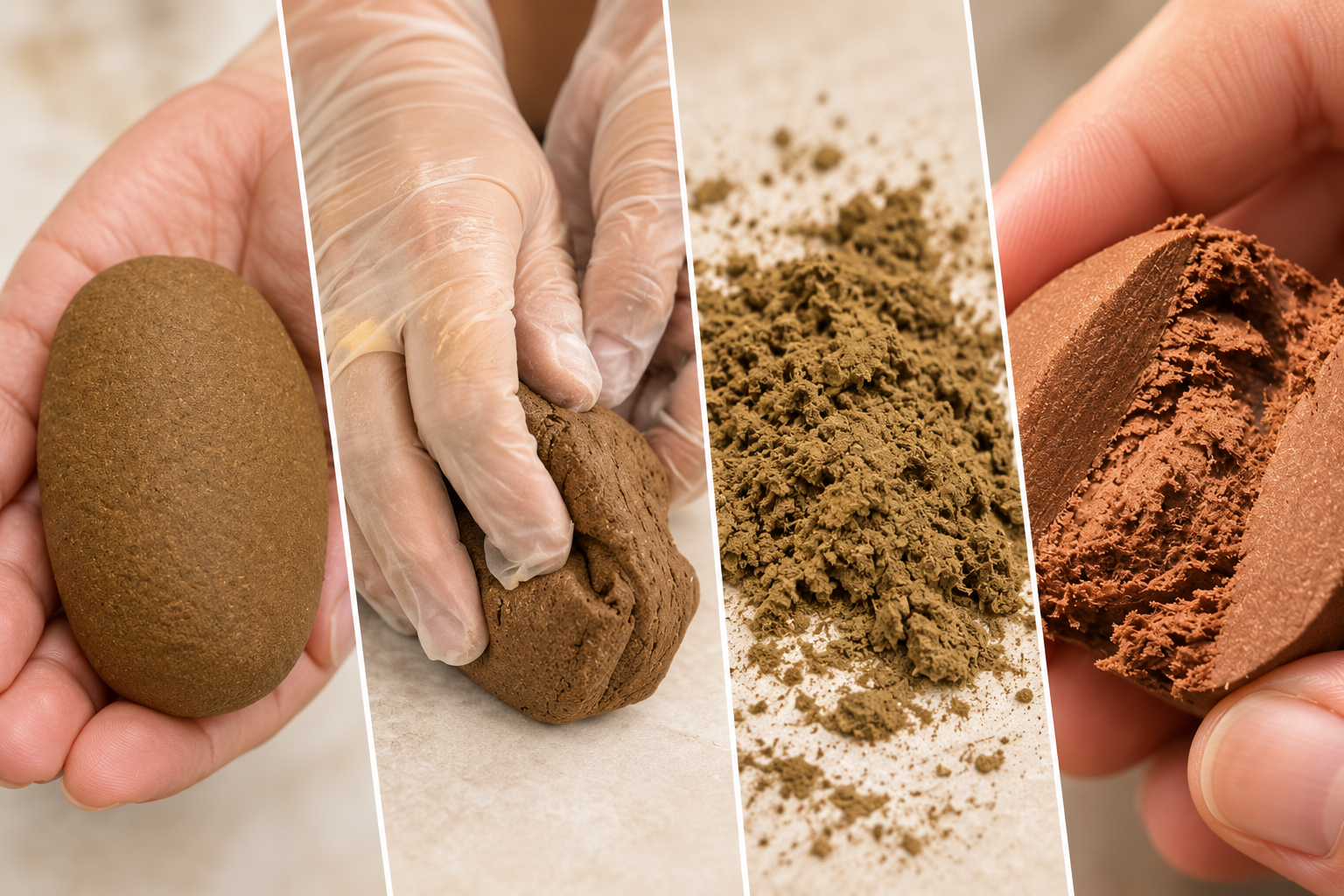
There are many ways to make incense by hand. Sticks and cones are the best known. We make ours into beads you can wear. Incense beads are made by grinding several plant materials into 120-mesh powder, blending them in set proportions and kneading the powder with a plant binder into a dough. Each bead is rolled by hand to 1.2 or 1.4 cm, set in a mold, shade-dried for seven days, then polished and strung. From preparing the powder to stringing takes about ten days.
Here is each step in order, what we do and why, with the numbers our own batches have given us: how much water to use, how to tell when a bead is dry, why beads crack or mold, and how to keep the scent. After that comes how incense beads compare with the rose petal beads of the Western tradition. For what incense beads are and how to wear them, see What Are Incense Beads?.
Choosing the Materials
A strand of incense beads is made from a group of plant materials. We sort them into four kinds. Aromatic woods such as sandalwood and agarwood form the base. Resins such as benzoin and frankincense round out the scent and also help with binding. Flowers and herbs such as rose, lavender and mint give each blend its character. Aged citrus peel such as chenpi adds a little brightness at the start. Each blend uses a different set. Singular Rose is built mainly on two kinds of rose and roselle. Green Hour is led by lavender over a base of sandalwood and agarwood.
Which materials we use depends on the scent a customer wants, or on a recipe we have already set. We pick plump, whole pieces, because they carry a fuller scent. Everything has to be fully dry. Wet material won’t grind fine, and beads made from it mold easily. Anything that smells musty or rancid goes. Origin matters too. The same plant from two regions can smell very different, so each of our raw materials comes from a fixed source to keep every batch consistent.
Preparing and Aging
Some materials can’t be used as they arrive. Old Chinese incense manuals describe soaking sandalwood in wine and stir-frying it with honey to take off its dry, harsh edge. Chenpi and mugwort are stored for years until their scent turns from sharp to mellow. Our own work has borne this out. Every material is prepared first, and aged as long as it needs, before it moves on. None of this shows in the finished bead.
Ground powder is spread out and left until it is completely dry before we use it. We don’t work through a stretch of rainy days. The air is too damp, the beads won’t dry through, and they mold easily.
Grinding and Sifting
Every material is ground and passed through a 120-mesh sieve. 120 mesh means 120 openings per linear inch of screen, so only particles smaller than about 0.125 mm get through.
We grind to this size for three reasons. First, the bead’s surface comes out smooth and doesn’t shed. Second, the tighter a bead is packed, the more slowly it releases scent, and ours stay clearly fragrant for 6 to 12 months. Sachets use a coarse grind packed loosely in cloth, which is why they smell stronger at first and fade faster. Old incense makers aimed for a grind neither too coarse nor too fine. Too coarse and the dough won’t hold its shape. Too fine and the scent fades faster. 120 mesh is the balance we reached by testing. Third, because the dough is packed tight, our beads weigh a little more than typical incense beads of the same size. You can feel it on the wrist.
We have tried 80 mesh. The scent lasted longer, but the beads didn’t look good. Coarse powder doesn’t leave pits, and the beads still polish smooth, but the larger grains show as patches across the surface. Go much finer than 120 and the scent fades quickly. Some materials are oily, too, and they are already hard to push through a 120-mesh sieve. Any finer and we couldn’t get usable powder from them at all. Many incense makers call 120 mesh the golden size. Finer isn’t better.
Blending
Traditional Chinese incense blending treats a formula the way a physician treats a prescription. Several ingredients become one scent, and each has a job. Woods and resins make up about 30 percent and carry the base and the staying power. Flowers and herbs take 30 to 50 percent and decide what you notice first. The binder takes 20 to 30 percent and decides how solid the bead is. Peel and clove go in only in small amounts, because a little more would cover everything else.
Every change to a recipe means five or six rounds of balancing tests, about two weeks in all, before we settle on it.
Kneading the Dough
The blended powder is mixed with a plant binder such as nanmu powder and a measured amount of purified water, then kneaded into dough. The amount of water decides whether the batch works. We use 0.7 times the weight of the powder, which works for anyone. Skilled hands can bring it down to 0.6 or even 0.5, but it takes real effort. More water means more evaporation, so the bead shrinks more. A bead that shrinks more has more pits on its surface, more has to be sanded away to make it round, and the finished bead ends up light and less handsome. With much more water, say 0.9 times, the dough turns into a sticky mush that clings to your hands, and you can’t work it at all. We use no synthetic glue. Nanmu powder releases a natural mucilage when it meets water, and that mucilage holds the scent powder together. We explain how in What Holds a Botanical Bead Together.
Kneading takes half an hour, with steady pounding along the way, until the dough feels like modeling clay and shows no pinholes on the surface. If the dough isn’t pounded enough and air stays trapped inside, the bead will crack as it dries. Then we wrap it and let it rest for half a day. Resting lets the scents of the materials blend further.
Rolling the Beads
We work out how many grams each bead needs for its finished size, weigh the dough into equal portions and roll each one round between the palms. Once it is nearly round, it goes into a mold to set its shape, and we pierce the hole with a needle while it is still soft.
With a 1.4 cm metal mold, each bead takes about 1.7 g of dough. To find the number, roll one bead, press it into the mold, trim off the excess, take it out and weigh it. Metal molds pack the dough tighter than acrylic ones. At the same diameter they take more dough and lose less to evaporation, but the beads take longer to dry.
Cracks start here. A hairline crack on the surface now becomes a crack in the dried bead. When we spot one, we repair it on the spot with a fingertip dipped in a little water, smoothed over the line.
Shade-Drying
The rolled beads are threaded onto steel needles, and the needles are set down to dry in the shade for seven days, with no sun and no oven. Sun or heat dries the outside before the inside, which cracks the bead, and the heat also drives off some of the scent.
We cover them with a paper box poked with a few holes and leave them alone. The first day matters most. The box lets moisture leave evenly, and a bead that doesn’t crack on day one rarely cracks later. Almost all cracking happens in the first two days, and the causes are few: a poor binder, too much water, careless unmolding, or drying too fast. So however hot or cold it is, we keep the air conditioner and the fan off while we make beads. Both change the humidity and dry the material too fast. The room needs fresh air, but the beads shouldn’t sit in a draft. One side dries faster than the other, and the bead loses its shape.
Seven days is the safe figure. One batch we made in late autumn in Zhejiang, at 25°C and 61% humidity indoors, with 1.4 cm beads, was essentially dry by day four. Heat, humidity and still, muggy weather all stretch the drying out. Bigger beads dry more slowly. So do beads made in a humid climate or in winter, and at 80 to 90 percent humidity they are hard to dry through. A heated room in a dry climate has the opposite problem. Too dry and the beads crack, so a cup of water set nearby helps.
How do you know they are dry? Weigh them. When the weight stops changing much, they are dry. Here is the average weight of 10 beads from a 1.4 cm metal mold, on a scale accurate to 0.01 g.
| Day | Average weight of 10 beads (g) |
|---|---|
| 0 (just molded) | 1.70 |
| 1 | 1.65 |
| 3 | 1.53 |
| 5 | 1.52 |
| 7 | 1.50 |
Over seven days the beads lost 0.20 g, about 12 percent. Most of it went in the first three days, 0.17 g. From day 3 to day 7 they lost only 0.03 g. Some Chinese makers say a dried bead keeps only 68 percent of its starting weight. Ours kept about 88 percent. The gap may come from weighing later than we did, or from acrylic molds, which many makers use. They don’t pack the dough as tight, so more water and more scent escape.
Don’t judge by the surface. The outside can be dry while the inside is still soft. We learned this early. When we polish, the bead is held in place by its hole. If the inside is still soft, the hole wears wider at high speed, the bead slips and it won’t polish round. Beads that aren’t fully dry also mold. White mold can be wiped off and the bead is still fine. Black mold means the bead is lost, and it is usually what grows when beads aren’t dry and the air doesn’t move. A bead turning soft again is the first sign of mold. Flowers and arborvitae seed are high in sugar and oil, so they take up moisture more easily. The recipe itself can help. Benzoin, frankincense, storax and myrrh all resist mold, and our recipes include benzoin and frankincense.
Polishing and Stringing
After drying, the beads still show marks from rolling, so we polish them. Coarse sandpaper takes off the excess first. Then 400, 1000 and 2000 grit refine the surface, and a wool felt pad brings up the shine. The finished beads are counted to the wrist size you enter when you order, strung on clear stretch cord and fitted with accessories. That is a strand of fragrance jewelry ready to wear.
So a strand takes at least ten days: one day to prepare the materials, one day to make the beads, seven days to dry and one day to polish and string. The wait is real.
Wearing and Caring for Incense Beads
For the first two weeks or so, the scent is strong. After that it softens but stays clear, and it stays that way for 6 to 12 months. Part of the fading is your nose getting used to it, and part is the scent really growing lighter. Seal the strand in a bag for a few days and the scent comes back. One of our own strands still smells after more than a year. Some say beads made by old methods kept their scent for 5 to 10 years. We believe that craft existed, but its materials and recipes have been lost. We recreate these old scented ornaments because we love them. Honestly, ours don’t last that long yet, and we keep working on it.
Take the beads off if your hands will be in water for a while, and it’s best not to wear them when your hands are sweaty. If they get wet, wipe them dry right away, or let them air-dry somewhere cool and shaded. Never put them in the sun or under a hair dryer. Left soaking for a long time, the beads will turn back into mud. If white fuzz appears in a damp season, put on gloves and rub it off, and the scent will return. Day to day, keep them in a bag with a desiccant packet. There’s no need to “pan” them either. In China, people often keep beads in hand for years, rubbing them between the fingers, and call it pan. Incense beads don’t need it. Just wear them.
How Incense Beads Differ from Rose Petal Beads
The West has its own way of turning plants into beads. The best known is rose petal beads. Fresh rose petals are mashed with water into a paste and simmered in an iron pan over several days. The iron darkens the paste as it thickens. The paste is rolled into beads, threaded on pins and left to dry for days or weeks, shrinking by about a third. These beads were often strung as rosaries.
Both turn plants into beads, by different routes.
| Rose petal beads | Incense beads | |
|---|---|---|
| Material | Fresh rose petals, one kind | Dried materials ground to powder, several blended |
| How it holds shape | Petal paste thickened by repeated heating | Plant binder and water kneaded into dough, set in a mold |
| Heat | Yes, over several days | None, shade-dried |
| Scent | Rose. Fades over time, and some makers add rose oil | Several materials blended into one scent, clearly fragrant for 6–12 months |
If you want to try homemade incense, rose petal beads are a good place to start. For the incense bead method, the end of What Holds a Botanical Bead Together gives a minimal recipe.
FAQ
Do incense beads expire?
Kept dry, they don’t go bad, but the scent fades. It is strong for the first two weeks or so, then softens but stays clear for 6 to 12 months. When it seems faint, seal the strand in a bag for a few days and it comes back. Damp is the real risk, because wet beads can mold.
How long does it take to make incense beads?
At least ten days: a day to prepare the powder, a day to knead, rest and roll the beads, seven days of shade-drying, then a day to polish and string. Preparing and aging the raw materials comes on top of that. A new recipe takes about two more weeks of testing before it is set.
How long do incense beads take to dry?
We allow seven days in the shade. In late autumn, at 25°C and 61% humidity, our 1.4 cm beads were essentially dry by day four, but bigger beads, humid weather and winter all slow it down. Weigh them. When the weight stops changing, they are dry. Never use the sun or an oven. The outside dries before the inside, and the bead cracks.
How should you store incense beads?
In a sealed bag with a desiccant packet, somewhere cool and out of the sun. Take them off before your hands go into water. If they get wet, wipe them dry at once and let them air-dry in the shade. Never use a hair dryer.
Are incense beads the same as rose petal beads?
No. Rose petal beads are made from a paste of fresh petals, thickened by repeated heating, and use rose alone. Incense beads are made from several dried materials ground to powder and held with a plant binder, with no heating.

No-Refill Aromatherapy Bracelet: Incense Beads
Aromatherapy bracelets need refilling every few hours. Incense beads hold the scent inside and stay clear for 6–12…
Natural Perfume Alternative: Scent You Wear, Not Spray
Natural perfume fades fast and may irritate skin. Here is another way to carry scent: plant beads worn…
What Holds a Botanical Bead Together
How plant powder becomes a wearable bead — without synthetic glue. Three natural binders, one shared rule: keep…
The scent behind this story
Singular Rose · Worn
Singular Rose is a rose scented bracelet, with a scent only the people near you will know. Mohong rose, Pingyin rose and roselle carry it, backed by woods and resins, for a creamy, full aroma. Hand-rolled from 120-mesh botanical powder, polished by hand and strung on clear stretch flat cord, with accessories in a choice of styles. Wear it alone or stacked.
Price range: $88.00 through $98.00
View product →