Scent as a small courtesy · Handmade in rural Zhejiang, China

Chenpi: The Aged Tangerine Peel Used in Tea, Cooking and Medicine
Citrus & Peels
Chenpi is tangerine peel that has been dried and then stored for years. In China it goes into cooking, tea and traditional medicine. It gets better with age, which is where the name comes from: chen means old. The best known comes from Xinhui in Guangdong. It smells of warm citrus. The taste is slightly sweet at first, then pungent and bitter.
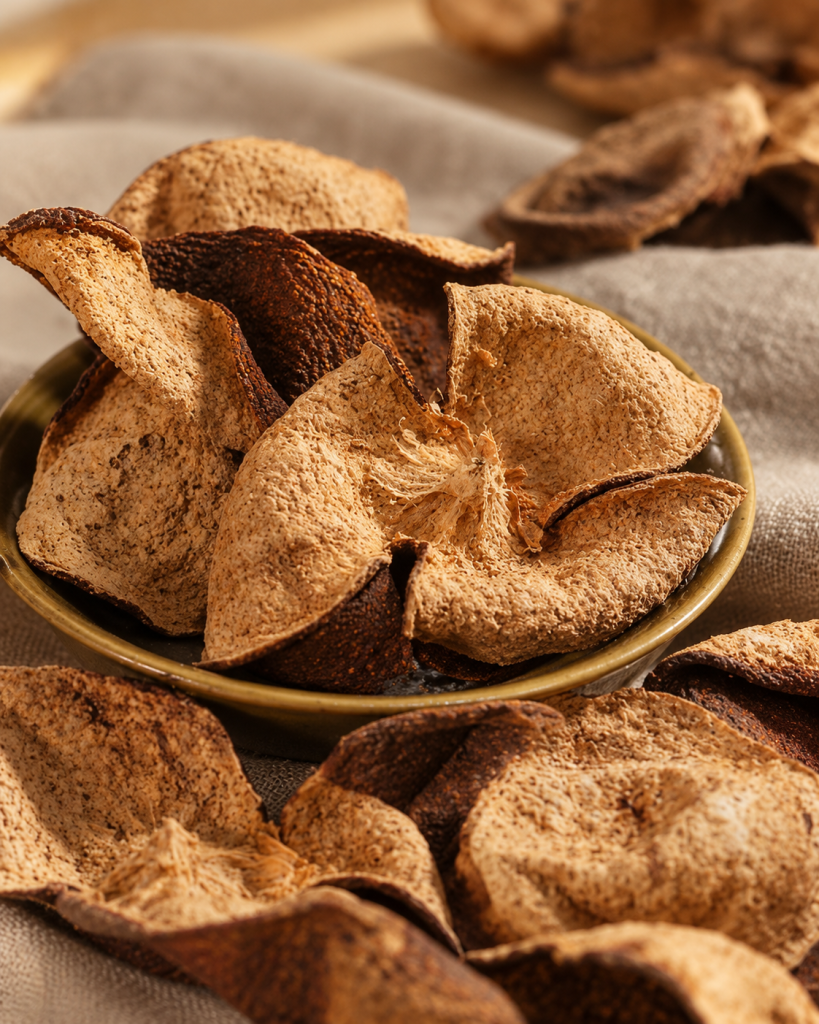
| Also known as | Chen pi, aged tangerine peel, dried tangerine peel. Called Xinhui peel when it comes from Xinhui |
| What it is | The ripe peel of the mandarin, Citrus reticulata, dried and stored for years |
| Scent | Warm citrus. The taste is slightly sweet, then pungent and bitter |
| Key compounds | D-limonene and γ-terpinene give the scent. It also holds flavonoids such as hesperidin, nobiletin and tangeretin |
| Grown in | Guangdong, Guangxi, Sichuan, Fujian and Zhejiang. Xinhui in Guangdong is the most famous |
| Common forms | Whole pieces, shreds, powder, capsules |
| Protection | A cultivated crop, not listed under CITES |
What is chenpi?
Chenpi is the peel of a fully ripe mandarin. Once dried, it is not used right away. It is kept dry and changes slowly, year after year. The redder it is and the longer it has been stored, the better it is. China’s official standard for medicinal herbs lists it.
Before use, soak it in cold water until soft, for no more than half an hour so the scent stays in. Then gently scrape off the white layer inside.
What does chenpi smell like?
Warm citrus. The taste is slightly sweet at first, then pungent and bitter. Most of the scent comes from its essential oil. In an analysis of 19 batches of chenpi, the main compounds found in every batch were D-limonene, γ-terpinene and myrcene.
The older it gets, the softer the smell. One study compared fresh Xinhui chenpi with peel stored for three years. In the older peel, 17 volatile compounds had dropped by different amounts, while flavonoids and color had gone up. The researchers saw this as the reason aged chenpi smells less sharp.
How do you use chenpi?
| Way | How | Good for |
|---|---|---|
| In cooking | Soaked, scraped and cut into shreds for red bean soup and other sweet soups, congee, duck, pigeon, mooncakes, mung bean soup and orange chicken. It is also used to take away the smell of fish | The kitchen |
| As tea | Steeped alone or with tea leaves | A warm drink |
| In spice blends | One of the spices in Japanese shichimi tōgarashi | The kitchen |
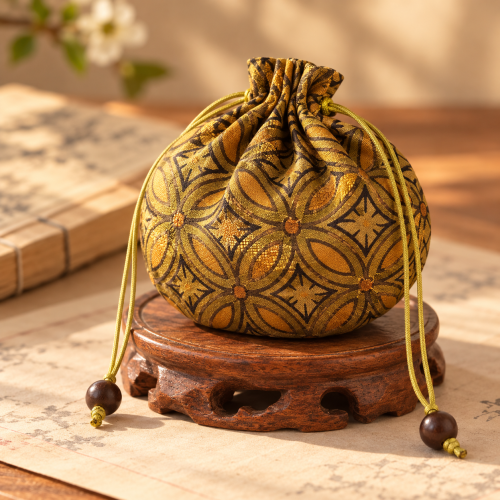
| In scent blends | A little in a sachet adds a touch of citrus to flowers or woods | Carried with you, a wardrobe |
| In medicine | A herb that regulates qi in Chinese medicine, used in thousands of formulas | Chinese medicine |
How is chenpi different from other materials?
Fresh peel vs peel aged three years
| Fresh (0 years) | Stored 3 years | |
|---|---|---|
| Volatile compounds (17) | Higher | Lower by different amounts |
| Synephrine | Higher | Lower |
| Flavonoids, antioxidant activity, color | Lower | Higher |
Chenpi from Guangdong is a protected geographical product and must be aged at least three years. How it is stored matters too. A 24-month study found that cold, dry storage (4°C, 35 to 40% humidity) slows the aging. Long spells of heat and damp (35°C, above 85% humidity) made the flavonoids drop twice as fast.
Chenpi vs green peel
Both come from the same mandarin. The difference is when the fruit is picked. Chenpi uses fully ripe, yellow fruit. Green peel, qingpi, uses young fruit that has not yet turned.
Often confused: other citrus peels
Some sellers pass off other citrus peels as chenpi. Here is how to tell them apart:
| Mandarin peel (chenpi) | Gan peel (a larger mandarin) | Pomelo peel | |
|---|---|---|---|
| Texture | Fine | Coarse | Coarser |
| Color and thickness | Red and thin | Yellow and thick | Yellow, thickest and spongy |
| Inside | Many fine fibers | Lots of white pith | Pith, no fibers |
| Taste | Bitter, pungent | Pungent, sweet | Mostly sweet, a little pungent |
Chenpi vs dried orange peel
In English, dried orange peel is often treated as the same thing. But chenpi comes from the mandarin, not the sweet orange, and it has to be aged.
Why is chenpi expensive?
The price depends on two things: how many years it has been aged, and whether it comes from Xinhui. Prices at the end of 2014:
| Age (Xinhui chenpi) | Price |
|---|---|
| 1 year | About HK$140 per kg |
| 10 years | HK$600 to 800 per kg |
| Over 20 years | Close to 24,000 yuan per kg |
There is another reason prices rose. From around 2010, much of Xinhui’s farmland was turned over to shops and housing, and both citrus and chenpi output fell.
What are the benefits of chenpi?
Chinese medicine treats chenpi as a herb that regulates qi. It is traditionally used for nausea, vomiting, indigestion and coughs with phlegm. Records of citrus peel as medicine go back nearly two thousand years. Most modern research has been done in labs and on animals. Human trials are few, and the results are mixed.
| Claim | Evidence | What was found |
|---|---|---|
| Digestion, breathing, inflammation, antioxidant | Lab or animal | A 2018 review: about 140 compounds have been isolated from chenpi. The essential oil and flavonoids are thought to be the main active parts |
| Blood fats | Human study (small) | A randomized, double-blind trial of 72 people (55 finished). After 8 weeks of a fermented chenpi drink, body weight and triglycerides fell. One author worked for the maker |
| Memory | Human study | 80 people with self-reported memory decline took citrus peel extract for 36 weeks. They improved, but so did the placebo group. There was no difference between the groups |
The US Food and Drug Administration has not approved chenpi for any medical use.
Chenpi in history and culture
A medicine that gets better with age
A few Chinese herbs are meant to be used only after they have aged. Chenpi is the most common of them. It was said to be something every household needed.
The best came from Guangdong
As early as the Ming dynasty, people rated peel from Guangdong the best, with peel from Jiangxi next.
The Xinhui chenpi trade
In the Ming and Qing dynasties, merchants from Xinhui shipped chenpi to other provinces, and local farmers grew rich on it. The trade faded in the 1990s. Around 2002, with help from the Xinhui agriculture bureau, growers set up a chenpi industry association, and chenpi became popular again.
On to Japan
Japan calls it chinpi too. It is a common ingredient in shichimi, the seven-spice blend.
Is chenpi safe?
As food, chenpi has been eaten in China and Japan for a very long time. Keep three things in mind:
- Watch for mold. China’s standard for medicinal herbs sets a limit for aflatoxin in chenpi. Avoid long spells of heat and damp in storage, and throw away any peel that has gone moldy.
- Do not overdo it. Chinese medicine holds that taking large amounts for a long time can do harm.
- Take care with citrus allergies. If you are pregnant, breastfeeding or on medication, ask a doctor before using chenpi as medicine.
Chenpi at ZendoDream
Chenpi has a cooling feel to it. Warmed, its scent opens up and leaves you feeling relaxed all over. Among people in China who drink and dry chenpi, the first rule is to tell aged scent from mustiness, and never take mold for age. Color gives a rough idea of age. Three-year peel looks redder, and thirteen-year peel is closer to black.
Genuine Xinhui chenpi is never steamed or boiled. It is sun-dried and left to age on its own. Many people simply dry their own on a windowsill or in a courtyard. Late October to December is the best time, when the north wind blows and the days are clear.
Chenpi has a long history in incense blending. It goes into incense and honey-bound pellets, and some people make cones and scent tablets with it. They say it brings the other materials together and takes the dry edge off them. There is even a Chinese perfume built around chenpi. It opens on aged peel and slowly turns into the smell of chenpi pu’er tea.
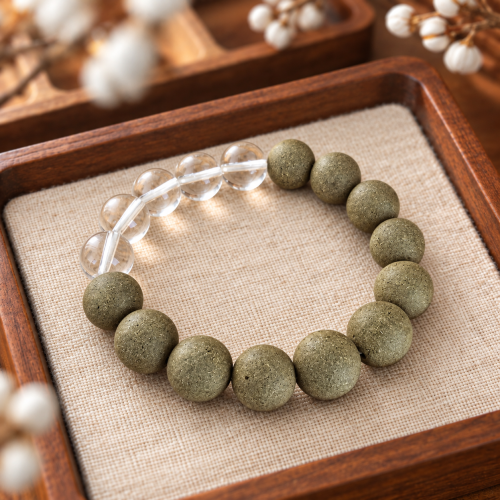
Chenpi is one of the peels in Green Hour · Worn: sweet, floral lavender softened by agarwood, with a gentle woody-herbal warmth. The beads are hand-rolled in the soft olive-green of dried herbs.
Pieces made with chenpi
-

Singular Rose · Carried
$58.00 -
Green Hour · Worn
Price range: $88.00 through $98.00Select options This product has multiple variants. The options may be chosen on the product page
FAQ
What is chenpi?
Chenpi is mandarin peel that has been dried and aged. It is the ripe peel of Citrus reticulata, used in Chinese cooking and medicine. Chen means old, and the older it is, the better.
Is chenpi the same as dried orange peel?
No. Chenpi comes from the mandarin, not the sweet orange. It is also stored dry for years. Chenpi from Guangdong must be aged at least three years.
What is Xinhui chenpi?
Chenpi from Xinhui in Guangdong, also called Xinhui peel. Many people rate it the best. As early as the Ming dynasty, peel from Guangdong was rated highest.
How long should chenpi be aged?
Chenpi from Guangdong, a protected geographical product, must be aged at least three years. A study of Xinhui chenpi found that after three years the volatile compounds dropped and the flavonoids rose. The price rises with age too. Ten-year peel costs about four to six times as much as one-year peel.
How do you make chenpi tea?
Steep chenpi alone or with tea leaves. Soak whole pieces in cold water first until soft, for no more than half an hour, so the scent is not lost.
What are the benefits of chenpi?
Chinese medicine treats it as a herb that regulates qi. It is traditionally used for nausea, indigestion and coughs with phlegm. Most modern research is in labs and on animals. Human trials are few. In one memory trial of 80 people, citrus peel extract did no better than a placebo.
Sources
- Chenpi, Wikipedia
- Yu et al., 2018, Journal of Ethnopharmacology, review
- Shi et al., 2024, Food Science & Nutrition, fresh vs three-year Xinhui chenpi
- Peng et al., 2025, Food Science & Nutrition, storage conditions
- Volatile oil of 19 chenpi batches, China Journal of Chinese Materia Medica, 2021
- Tan et al., 2025, Frontiers in Endocrinology, 72-person trial
- Galluzzi et al., 2024, Nutrition Journal, 80-person trial
- Bencao Gangmu, Fruit section, via Wikisource
This page is for general education. Health claims from traditional use and studies are not medical advice.