Scent as a small courtesy · Handmade in rural Zhejiang, China

Osmanthus: How It Smells, Osmanthus Tea, and Dried Osmanthus Flowers
Flowers
Osmanthus is an evergreen shrub or small tree in the olive family, Osmanthus fragrans. In Western gardens it is also called sweet olive or tea olive. The flowers are tiny, grow in clusters in autumn, and smell strongly. Dried osmanthus is the flower picked and dried. You can steep it as tea, bake with it, or blend it into incense.
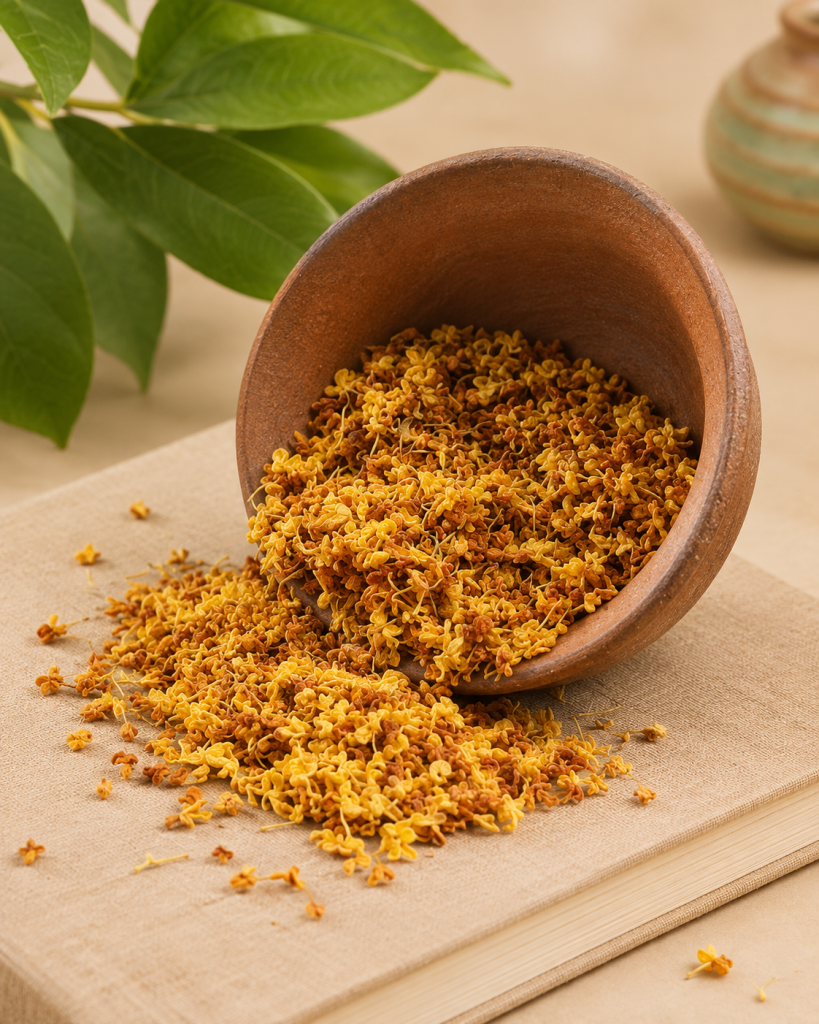
| Also known as | Osmanthus, sweet osmanthus, sweet olive, tea olive. Botanical name Osmanthus fragrans |
| Chinese names | gui hua (桂花), also mu xi and yan gui |
| What it is | The flower of an evergreen shrub or small tree in the olive family |
| Blooms | September to October |
| Scent | Sweet and floral, with a touch of fruit |
| Common forms | Dried flowers, sugared flowers, tea, wine, absolute |
| Protection | A cultivated plant, not listed under CITES |
What is osmanthus?
It is an evergreen plant, usually 3 to 5 m tall and up to about 10 m. The small flowers open in September and October in yellowish, yellow or orange, and the purple-black fruit ripens the following March.
Cultivars are often sorted into groups by flower color and bloom time: the silver-white Albus group, the golden-yellow Luteus group, the orange-red Aurantiacus group, and the Asiaticus group. These are cultivars, not separate species. The cultivars used in scent research come from these groups.
What does osmanthus smell like?
Sweet and floral, with a touch of fruit.
The chemistry of the scent has been studied quite a bit. A 2017 study measured the scent of whole flowers from four cultivars and found 53 volatile compounds. The most abundant were linalool, alpha-ionone, beta-ionone and gamma-decalactone. A review calls the two ionones the most important scent molecules and says the silver-white group has the highest levels. The proportions differ a lot between cultivars, and the scent of the flower changes with temperature, so there is no single set of numbers for osmanthus.
How do you use osmanthus?
| Use | How | Good for |
|---|---|---|
| Tea | A small pinch of dried flowers in hot water, alone or with green or black tea | A warm drink |
| Sweets and wine | A review lists desserts, pastry, tea and wine | The kitchen |
| Incense | Ground to a fine powder and added to incense beads and pellets, or rolled onto the surface, adding sweet floral to woods | At home |
| Fragrance extract | The flowers are made into an absolute for perfume and flavor | Industry |
If you plan to eat it, buy flowers labeled edible.
Where does osmanthus come from?
It is native to China and grown across Asia. Hangzhou, Suzhou and Guilin have all named it their city flower.
What are the benefits of osmanthus?
Old Chinese herbal texts record osmanthus flower as a remedy for bad breath. We found no human studies of dried osmanthus flower or osmanthus tea.
| Claim | Evidence level | What the research found |
|---|---|---|
| Treats bad breath | Traditional use | A traditional Chinese medicine claim, quoted in the review from an old herbal text |
| Protects nerves, heart, kidney and more | Lab or animal | A 2022 review lists single compounds isolated from the petals, such as dihydroquercetin, astilbin and diosmetin, with effects seen in rats, mice or cells. Dihydroquercetin, for example, was tested for 12 weeks in 65 rats with diabetic kidney disease |
| Human trials | None | The review lists no human trials of the flower or its extract |
These studies used single compounds isolated from the flower. They did not test the flower or the tea. Results in animals and cells do not show that drinking osmanthus tea has the same effect.
Osmanthus in history and culture
Osmanthus is closely tied to the Mid-Autumn Festival. Osmanthus wine is traditionally drunk as a reunion wine.
A well-known Chinese legend says a cassia tree (gui) grows on the moon. Wu Gang was condemned to chop it down, but the cut closes up at once, so he can never finish. This is why the moon and osmanthus are so often mentioned together in China.
Is osmanthus safe?
We found no authoritative safety data on dried osmanthus flower, and the review reports no safety or toxicity data for the flower or its extract. As a food or tea, keep in mind:
- Source. Buy only flowers labeled edible and grown without pesticides.
- Ask a doctor before medicinal use. This matters most if you are pregnant, nursing or on medication.
Osmanthus at ZendoDream
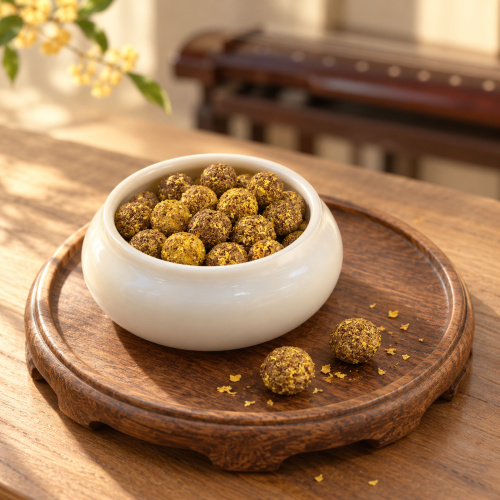
In Osmanthus Moon · Heated, osmanthus is the largest single ingredient, 38.3% of the solids by weight, and the pellets are rolled in ground osmanthus. They are hand-rolled with honey and heated at 150°C / 300°F, never burned, with no smoke and no ash. Once warmed, the sweetness of osmanthus opens quickly and takes you back to autumn.
The rest of the blend is Mohong rose, sandalwood, agarwood, lemongrass, clove and honey.
In China, osmanthus is known for a scent that is hard to keep. People find that dried osmanthus loses much of its scent after two days in a bag. Picked flower by flower, it changes quickly. To keep the scent you smell in the air, you have to cut a whole branch and stand it in water.
Good dried osmanthus is golden and crumbles when you rub it between your fingers. Among the varieties, silver and four-season osmanthus smell lighter and fresher.
Because the scent is so hard to keep, we store our osmanthus carefully and only take it out to make your pellets after you order. It is also why returned products can’t be resold: the materials don’t keep.
Pieces made with osmanthus
FAQ
What is osmanthus?
Osmanthus is the flower of an evergreen shrub or small tree in the olive family, Osmanthus fragrans. It is also called sweet osmanthus and blooms from September to October.
What does osmanthus smell like?
Sweet and floral, with a touch of fruit. The main scent molecules are linalool, the ionones and gamma-decalactone, and the proportions vary a lot between cultivars.
How do you make osmanthus tea?
Put a small pinch of dried osmanthus flowers in hot water. You can brew it alone or with green or black tea.
What are dried osmanthus flowers used for?
Tea, desserts and wine. They can also be ground into powder for incense beads and pellets.
When does osmanthus bloom?
September to October.
What are the benefits of osmanthus tea?
Traditional Chinese medicine records osmanthus flower as a remedy for bad breath. We found no human studies of osmanthus tea. The experiments that exist used single compounds from the flower, in animals or cells.
Is osmanthus safe?
We found no authoritative safety data on dried osmanthus flower. Buy flowers labeled edible and grown without pesticides, and ask a doctor before medicinal use.
Sources
- Fu J et al. 2017, floral scent of four Osmanthus fragrans cultivars at different temperatures, Molecules 22(3):430 (DOI 10.3390/molecules22030430)
- Review of Osmanthus fragrans secondary metabolites and medicinal value, 2022, Frontiers in Pharmacology (10.3389/fphar.2022.922204)
- Flora of China, Oleaceae, Osmanthus fragrans (Vol. 15, p. 292; height, flower color, bloom time, fruit)
This page is for general information only. Traditional uses and research findings are not medical advice.